This post contains affiliate links. If you buy through them, I may earn a small commission at no extra cost to you.
Ever drawn a butterfly with gorgeous patterns that still looked a little off, like it was about to tip sideways? Nine times out of ten, the wings were never quite a matching pair.
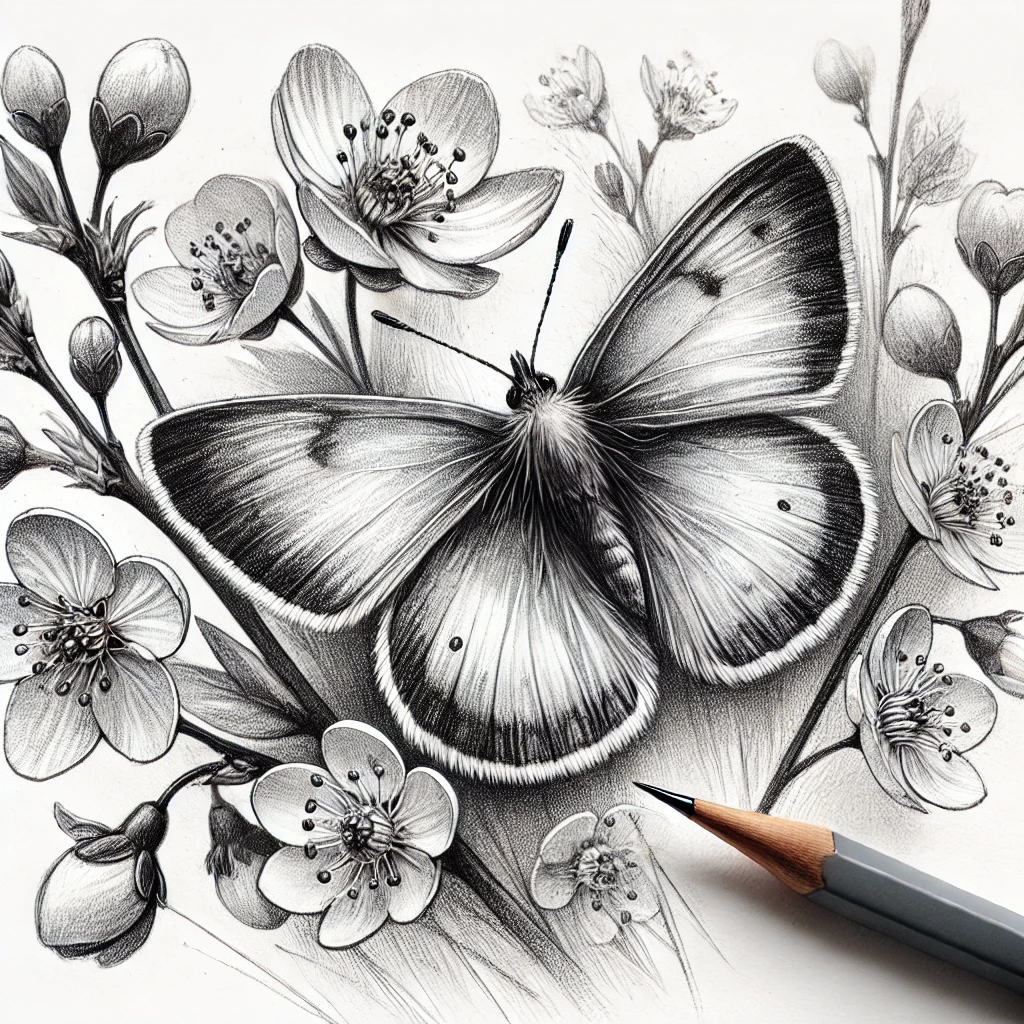
My point of view: a realistic butterfly is a symmetry problem first and a pattern problem second. Get the body centered and the wings mirrored, and even simple shading looks lifelike. Skip that, and no amount of detail will fix it.
Butterflies aren’t only a spring subject, either. Swallowtails fill summer gardens, and the monarch’s fall migration is one of the most beautiful things you can draw all year. This tutorial works in any season.
Quick answer: if you only do one thing, draw a light vertical centerline first and build the wings on one side only. Then trace the mirror image onto the other side with a light pad or the fold-and-trace trick below. Perfect symmetry, zero guesswork.
Butterfly anatomy in two minutes
You don’t need a biology degree. You need to know which parts exist and where they attach, because that’s what makes a drawing believable.
| Part | What it looks like | Drawing tip |
|---|---|---|
| Head | Small round bead | Add 2 large eyes |
| Antennae | 2 thin lines, clubbed tips | Draw the club, skip the zigzag |
| Thorax | Short, thick, fuzzy middle | All wings and legs attach here |
| Abdomen | Long, slim, segmented tail end | Light bands show segments |
| Wings | 2 forewings, 2 hindwings | Forewings overlap the hindwings |
| Legs | 6, attached to the thorax | Often tucked in or hidden |
A few details that separate “realistic” from “cartoon”:
- Four wings, not two. The forewings are usually larger and more triangular. The hindwings are rounder and tuck behind them.
- The club on the antennae. Butterfly antennae end in a small knob. Feathery antennae belong to moths, so this one detail tells the viewer exactly what they’re looking at.
- Wings attach to the thorax, not the abdomen. Many drawings hang the wings off the middle of a long body. Pull them up toward the head end.
- Legs are optional to show. All butterflies have six legs, but in many species, monarchs included, the front pair is small and folded up. In a top-down view you’ll often see few or none.
- Veins radiate from the wing base. They fan outward from where the wing meets the thorax, like the ribs of a paper fan.
Supplies for a realistic butterfly drawing
Nothing fancy is required. Here’s what I recommend for graphite work, with optional color.
- Graphite pencils, H through 6B. A graphite drawing pencil set gives you the full range. H for sketching, 2B for midtones, 4B to 6B for the darkest veins and body.
- Two erasers. A kneaded and precision eraser set lets you lift soft highlights and clean crisp edges.
- Blending stumps. Blending stumps smooth the wing gradients without smudgy fingerprints.
- Smooth, heavyweight paper. Smooth bristol-style paper holds fine detail and takes erasing well.
- Fine ink pens (optional). Fine-line ink pens are great for crisp vein lines in a stylized version.
- Watercolor (optional). A compact watercolor set for adding color once the drawing is done.
- A white gel pen. For the final sparkle on wing dots and the eye.
If you’d rather grab one bundle, a complete sketching kit covers the pencils, erasers, and stumps in one box.
How to draw a realistic butterfly in 6 steps
Step 1: Choose a clear reference
Pick a photo taken straight on from above, with the wings fully open. Angled photos are lovely but much harder, so save those for later. Butterfly gardens, nature photography sites, and field guides are all great sources.
Spend one full minute just looking. Notice where the darkest areas are and how many spots sit along the edge.
Step 2: Build the framework
Draw a light vertical centerline with an H pencil. Along it, sketch three ovals for the body: a small circle for the head, a short fat oval for the thorax, and a long slim oval for the abdomen.
The abdomen is usually about as long as the hindwing. If yours reaches past the hindwing’s bottom edge, shorten it.
Step 3: Draw one side of the wings, then mirror it
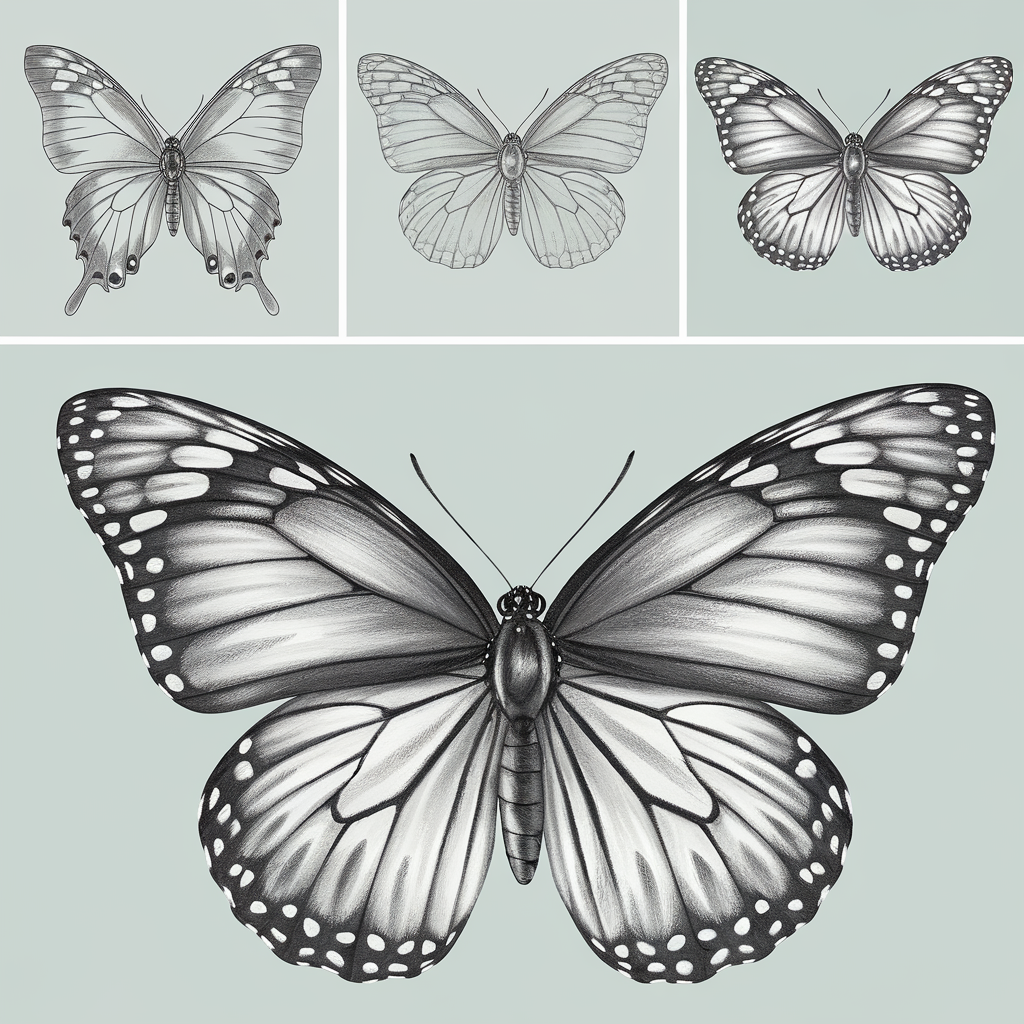
Sketch the forewing as a rounded triangle starting at the top of the thorax. Tuck the hindwing beneath it, a softer rounded shape. Keep the lines light.
Now the symmetry trick:
- Light pad method: finish one side, flip the paper over on a light pad, and trace the shape onto the back. Flip it again and trace through to the front on the empty side.
- Fold-and-trace method: fold the paper along the centerline, hold it against a bright window, and trace the visible wing onto the blank half.
Either way, you’ll have two matching wings in about five minutes.
Step 4: Divide the wings with veins
Draw the veins fanning out from the wing base, the way they appear in your reference. Most species have a long closed cell near the center of the forewing, with several veins branching toward the edge.
Keep these lines thin. Veins carry the pattern in the next steps, so they need to be accurate more than they need to be dark.
Step 5: Add value and texture
Shade the body first with a 2B to 4B pencil. Use short, fuzzy strokes on the thorax, since it’s covered in fine hairs, and light curved bands across the abdomen.
For the wings, build value in thin layers:
- Lay a light, even tone over each section with soft pressure.
- Blend with a stump to remove pencil texture.
- Add darker layers along the veins and outer edges.
- Lift highlights with the kneaded eraser pressed into a point.
Wing scales give butterflies a velvety, matte look, so keep transitions soft. Sharp, glossy highlights belong on the eyes only.
Step 6: Refine and finish
Deepen the darkest areas with a 6B: the vein lines, the wing borders, and the shadow where the wings meet the body. Then add the white gel pen dots along the edges and a tiny catchlight in each eye.
Step back a few feet. If one wing looks heavier, it usually needs a lighter value somewhere, not more detail.
If you learn better by watching, this demonstration walks through the process:
Species pattern guide
Once the steps feel easy, change the species. Each one teaches a different skill.
| Species | Top-side colors | Signature detail | Best season |
|---|---|---|---|
| Monarch | Orange, black veins | White dots in black borders | Summer to fall migration |
| Tiger swallowtail | Yellow, black stripes | Tails on the hindwings | Spring to summer |
| Blue morpho | Iridescent blue | Brown eyespots underneath | Any season (tropical) |
Monarchs: a perfect fall subject
Monarch wings are a lesson in contrast. Shade the black veins and borders fully dark, then leave the orange cells as clean midtones in graphite. The white border dots come in two loose rows, so space them with care.
Each fall, eastern monarchs travel south toward their overwintering grounds in Mexico. A monarch drawing on a sketchbook page between late summer and October feels right for the season.
Swallowtails: practice the silhouette
The tails on the hindwings change the whole outline. Draw them as slim extensions from the bottom edge, and keep the black stripes running in the same direction across both wings.
Blue morphos: shading iridescence
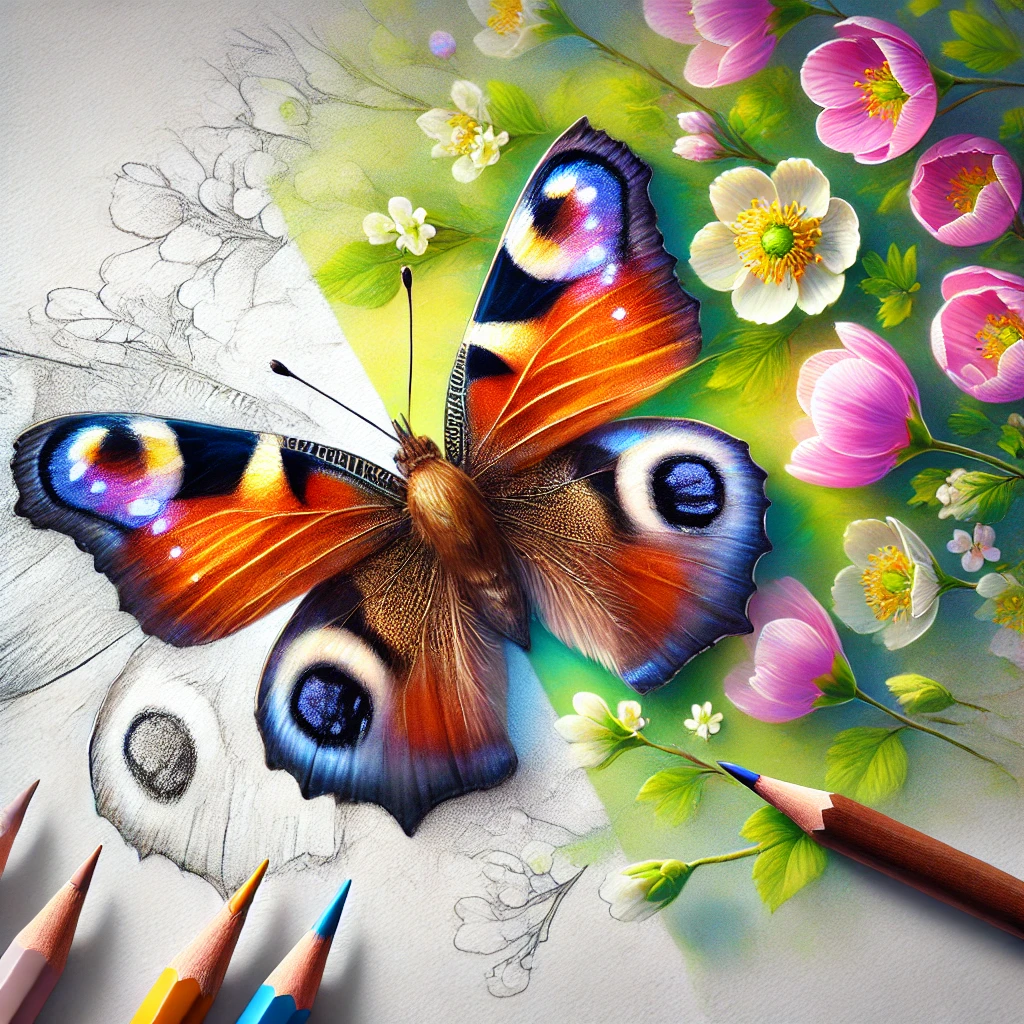
The top of a morpho wing shifts in color as light moves, so graphite versions rely on value. Keep the center of each wing lighter and darken toward the black edges. If you draw the underside instead, the brown eyespots become the star.
Common mistakes (and quick fixes)
- mismatched wings
- wings attached to abdomen
- dark heavy outlines
- feathery antennae
- flat even shading
- draw one side and mirror
- attach wings at the thorax
- let value make the edges
- add clubbed tips
- layer light to dark
The biggest one is outlining everything in dark pencil at the start. Real wings have soft edges defined by contrast, so a hard outline flattens them. Keep your early lines light enough to erase.
Take it further
- Add color. Lay watercolor washes once the graphite is set, or layer colored pencil over light graphite.
- Add a flower. A butterfly resting on a coneflower or lilac adds a story and teaches overlapping. The botanical sketching book is a lovely companion for the flower half.
- Try a side view. A butterfly with closed wings shows the underside pattern and is a great second challenge.
Pairing butterflies with flowers? Read Botanical Sketching 101 and how to draw botanical illustrations next.
Investment pieces worth it
You can draw a beautiful butterfly with a pencil and a window. These are for when butterflies (and nature drawing in general) become a regular habit.
A light pad makes the mirror trick fast and clean, and it pays off far beyond butterflies.
A large light pad for mirror tracing
The Artograph LightPad 950 LX is around $280 and gives you a 24×17 inch glowing surface. Trace symmetrical subjects, transfer sketches to good paper, and refine drawings without erasing holes in your final sheet.
The math: $280 over three years of weekly drawing sessions is about $1.80 a session.
Worth it if you draw symmetrical subjects, botanicals, or like to sketch roughly and then transfer clean. Skip it if you draw only occasionally. A sunny window does the same job for free.
Professional colored pencils
The Faber-Castell Polychromos 120 tin is around $295. Oil-based leads layer cleanly without waxy buildup, which matters for the many thin layers a monarch’s orange or a morpho’s blue needs.
Worth it if you already love colored pencil and want lightfast color that layers well. Skip it if you’re still exploring. A smaller set teaches the same skills.
A professional watercolor travel tin
The Winsor & Newton Professional Complete Travel Tin runs around $143. Professional pigments give brighter, cleaner washes, and the tin goes with you to the garden when butterflies are actually out.
Worth it if you plan to paint outdoors or add color to most of your drawings. Skip it if graphite is your happy place.
The takeaway
Center the body, draw one side, and mirror it. Then let soft layers of value do the work that heavy outlines can’t. Once the symmetry is right, every species becomes a fun pattern puzzle instead of a frustration.
Which butterfly do you want to draw first: a monarch, a swallowtail, or a blue morpho? Tell me in the comments, and save this tutorial to your drawing board for your next sketch session.