This post contains affiliate links. If you buy through them, I may earn a small commission at no extra cost to you.
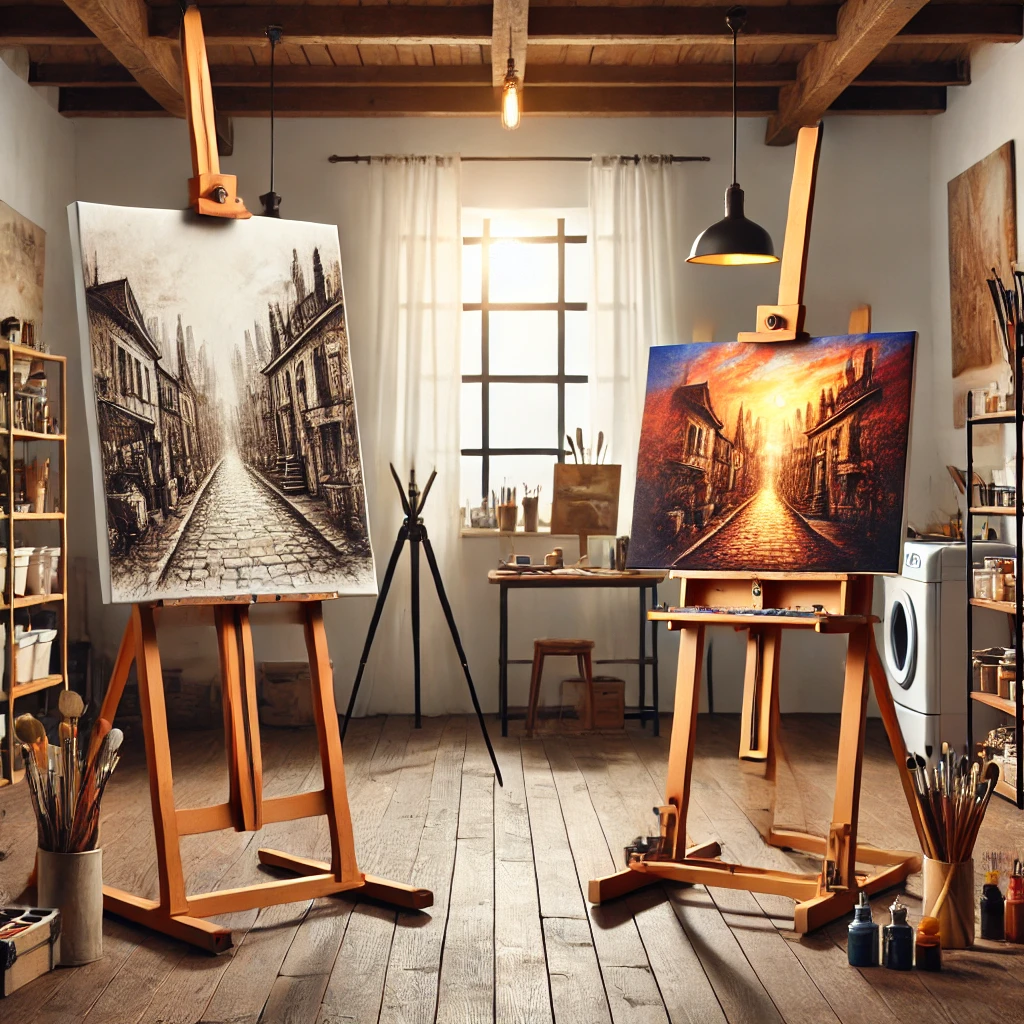
One easel looks like a sturdy little doorway. The other looks like a tripod that went to art school. Both hold a canvas, so why does the choice matter so much?
My take: pick an H-frame if your easel will stay put, and an A-frame if it has to move or fold away. Canvas size and budget matter too, but that one question about where the easel lives settles most cases before you even look at prices.
Quick answer: big canvases, heavy oils, a permanent studio corner? H-frame. Small room, canvases under about 30 inches, or you paint in different spots? A-frame. Still unsure? The four questions below will decide it for you.
H-frame vs A-frame at a glance
- rectangular frame
- wide base
- very stable
- holds big canvases
- heavier
- three legs
- folds flat
- lighter
- smaller footprint
- lower price
| Feature | H-frame | A-frame |
|---|---|---|
| Stability | Excellent | Good |
| Floor space (approx.) | About 2.5 x 2.5 ft | About 2 x 2 ft open |
| Max canvas | Larger, check listing | Smaller, check listing |
| Portability | Low, stays put | Folds and carries |
| Price tier | $$ to $$$ | $ to $$ |
The footprints are approximate and vary by model. For max canvas height, always check the listing, because brands measure it differently.
What is an H-frame easel?
An H-frame is built from vertical posts and horizontal crossbars on a wide, rectangular base. Seen from the front, the frame looks like the letter H. That shape spreads the weight of the canvas evenly, which is why H-frames feel so solid when you press a brush against them.
Most are made from hardwood such as beech, and many let you raise the canvas high and tilt the mast forward or back.
Why painters love them:
- Very steady, even with heavy canvases and vigorous brushwork
- Usually hold taller canvases than A-frames
- Height and tilt adjustments lock firmly
- Some models tilt all the way flat for watercolor
What to know before you buy:
- They’re heavy, so moving one across the room takes effort
- The base takes up more floor space
- They cost more, though a good one lasts for years
A solid all-rounder is the Mont Marte tilting studio easel, around $180 at the time of writing. It tilts to cut glare and stays steady for everyday painting on medium canvases.
What is an A-frame easel?
An A-frame (also called a tripod or lyre easel) has two front legs and a single rear leg that meet at the top, forming a triangle. Fold the back leg in and the whole thing slides behind a door or into a closet.
Why artists love them:
- Lightweight and quick to set up
- Smaller footprint, friendly to apartments and bedroom studios
- Usually the more budget-friendly option
- Lovely for displaying finished work, too
What to know before you buy:
- Less stable under big canvases or heavy pressure
- Lower maximum canvas height on most models
- Fewer tilt options
A good everyday pick is the MEEDEN A-frame easel, a beechwood tripod-style easel that folds neatly when you’re done.
Want more choices beyond these two styles, including tabletop, wall-mounted, and travel easels? See my guide to the best multi-use easels.
Match your easel to your canvas size
This is the chart I’d check first. If your favorite canvas sits in the bottom rows, the decision is easy.
| Canvas height you paint most | Best easel style | Why |
|---|---|---|
| Under 16 in | Tabletop or A-frame | Big easels are overkill |
| 16 to 30 in | A-frame or small H-frame | Either works, pick by space |
| 30 to 48 in | H-frame | Needs a steady base |
| Over 48 in | Large H-frame or crank | Check listing max height |
Choose in 4 questions
- Where will it live? If the easel stays set up in one corner, an H-frame earns its floor space. If it has to fold away after every session, go A-frame.
- How big do you paint? Use the chart above. Canvases over about 30 inches lean H-frame.
- What medium? Oils and heavy acrylics love the stability of an H-frame. Watercolor needs a surface that tilts flat, so look for a convertible H-frame or use a tabletop easel.
- What’s your budget? A-frames usually cost less. If you can only buy once, buy for the biggest canvas you paint regularly.
Set up either easel at the right height
Whichever style you pick, the setup is the same, and it costs nothing.
- Canvas center at eye level keeps your neck relaxed. Your neck will thank you after a long session.
- A slight forward tilt cuts glare from overhead lights.
- Step back often. Both easel styles make it easy to check your painting from 6 to 8 feet away.
Investment pieces worth it
If you’ve decided on an H-frame and plan to paint big for years, these are the ones I’d look at.
MEEDEN Extra Large Heavy-Duty H-Frame Studio Easel, solid beech (see it here), around $220. Worth it for painters who work on large canvases every week and want a base that doesn’t budge. Skip it if you rarely paint over 24 inches or need to fold your easel away.
MEEDEN Extra-Large H-Frame (see it here), around $275, listed as holding canvases up to about 79 inches. Worth it for statement pieces and tall panels. Skip it if your ceiling is under 8 feet, because a tall mast needs headroom.
Mont Marte tilting studio easel (see it here), around $180. Worth it if you want H-frame stability without the extra-large footprint. Skip it if your room only has space for a folding easel.
Cost-per-use check: $220 over three years of weekly painting is about 150 sessions, roughly $1.50 a session. Not bad for something you lean on every time you paint.
FAQ
Which easel is better for beginners?
An A-frame is a friendly, budget-conscious start for small to medium canvases. If you already know you love painting large, skip ahead to an H-frame so you only buy once.
Which easel works best in a small space?
An A-frame. It has the smaller footprint and folds away. A tabletop easel is another great small-space option.
What’s the best easel for large canvases?
An H-frame, ideally with a crank or a tall mast. Check the listing for the maximum canvas height before ordering.
Which easel is best for oil painting?
Many oil painters prefer an H-frame for its stability. Painting vertically also helps keep dust and stray hairs from settling on your wet surface.
What about plein air painting?
Neither is ideal. A French easel or a lightweight field easel packs paints, palette, and canvas into one carryable unit.
Is there an easel that does both?
Yes. Convertible H-frames tilt from upright to flat, so they handle oils and watercolor. The MEEDEN Versatile H-frame is a good example, covered in my multi-use easel guide.
The takeaway
Choose an H-frame for big canvases and a permanent spot, and an A-frame for smaller work and rooms that need to change shape. Match the easel to the canvas you paint most, set the center at eye level, and you’re ready.
Which team are you on, H-frame or A-frame? Tell me what you paint on in the comments.