This post contains affiliate links. If you buy through them, I may earn a small commission at no extra cost to you.
You’ve saved a hundred dreamy studio photos, and every one of them seems to have a whole sunlit room. Here’s the secret: most of those beautiful shots are of one corner, framed well.

My point of view: a small art studio looks Pinterest-worthy when everything messy is hidden and everything pretty is on purpose. Size matters much less than you think. Closed storage, one calm color palette and one statement piece will beat a big cluttered room every time.
If you only do one thing: put everything that isn’t beautiful (cords, half-empty tubes, paper scraps) into closed drawers or a lidded cart. What’s left on view instantly looks styled.
How much space do you need?
Less than you’d guess. A focused 4×6 foot corner can hold a full drawing or watercolor setup. Here’s how different spaces work.
| Space | Rough size | Layout | Key piece |
|---|---|---|---|
| Closet | 2×4 to 3×5 ft | Desk inside, doors close | Wall-mounted table |
| Bedroom corner | 4×6 ft | L-shape: desk plus cart | Rolling cart |
| Window nook | 3×5 ft | Desk facing the window | Daylight lamp |
| Spare wall | 2 ft deep x 6 ft | Fold-down table plus grid | Wall grid panels |
Need furniture that folds, rolls or hides? See art furniture essentials for small spaces.
Step 1: Choose the right spot

Light first, quiet second. A spot near a window gives you soft daylight for most of the day, and a corner away from the TV gives you focus.
- Best: a north-facing window, which gives steady, even light without harsh sun.
- Fine: any window, with a sheer curtain to soften direct sun.
- No window? Plan on a 5000K daylight lamp from day one.
Pick a spot you can leave set up. A studio you have to unpack every time is a studio you won’t use.
Step 2: Use space-saving furniture
In a small studio, every piece of furniture should fold, roll or stack. Here’s the layout I’d plan for a 4×6 foot corner, from wall to floor.
A wall-mounted folding table

A wall table around 31 by 24 inches folds flat when you’re done, so the corner turns back into a room. It’s ideal for sketching, watercolor and small paintings.

A rolling stool
A round rolling stool tucks under the table and scoots between your desk and the cart. It takes up a fraction of the space of a full chair.

A rolling cart

A 3-tier cart is the small studio’s best friend. Top tier for daily tools, middle for paint and paper, bottom for the bulky stuff. 3-tier rolling cart
Comparing carts? My roundup of the best rolling art carts covers sizes and finishes.
Step 3: Organize for easy access
Small spaces get messy fast because everything competes for the same few inches. The fix is simple: things you use every session stay within arm’s reach, and everything else goes up or away.
Clear desktop drawers
Small clear drawers keep pens, erasers and tape sorted where you can see them. A 16-drawer unit takes about the same footprint as a sheet of paper.

Wall grid panels

Grid panels turn a blank wall into storage you can rearrange anytime. Clip on cups for brushes, hang small baskets for tubes, and pin up sketches in between. The set below even comes with string lights for a soft glow.
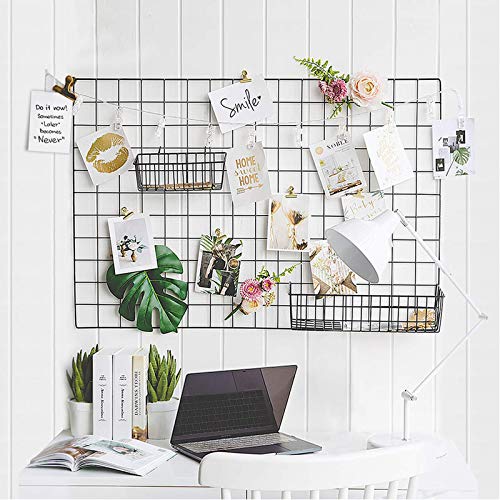
A pegboard kit works the same way if you prefer the classic look.
Find more ideas in wall-mounted organizers for art studios and small art studio organization ideas.
Step 4: Create a mood board wall
This is the part that makes a small studio feel like yours. Pin up color swatches, sketches you love, postcards, fabric scraps and anything that sparks an idea.
- Keep it to one area about 2 by 3 feet, so it reads as a feature and not as clutter.
- Stick to three or four colors that repeat across the rest of the corner.
- Swap pieces out each season so it stays fresh.
Step 5: Make it comfortable

You’ll stay longer in a studio that feels good to sit in. Match your seat to your table height so your feet rest flat and your arms land on the table comfortably.
A comfortable task chair
If you have room for a full chair, a white task chair keeps the look light and airy. Around $95.

Good light

Bright, true-color light makes your colors look right and your space look bigger. An LED desk lamp with several color modes lets you switch between warm for sketching at night and cool daylight for color work.

An adjustable task light with a clamp base saves desk space too.
Step 6: Keep it clean
A small studio stays Pinterest-worthy only if it’s easy to reset. Give yourself a five-minute closing routine.
- Wipe the table with reusable wipes.
- Sweep eraser crumbs and pencil shavings with a mini desktop vacuum.
- Put the day’s tools back in the top cart drawer.

Make it photograph well

A small studio can look stunning in photos with a few simple choices.
- one color palette
- closed storage
- one statement piece
- daylight from the side
- mixed colors
- open bins
- many small decor items
- overhead light only
- Pick one palette. Warm neutrals, soft greens or crisp white with wood all photograph beautifully.
- Hide the messy stuff. Closed drawers and lidded bins make a corner look calm.
- Choose one statement piece. A vintage frame, a big plant, or a painting in progress on a small easel.
- Shoot in daylight. Morning or late afternoon light from the side gives soft shadows.
Your one-weekend makeover plan
You don’t need a month. Here’s how I’d do it in a weekend.
| Day | Task | Time |
|---|---|---|
| Saturday | Clear the spot, measure, mount table and grid | 4 to 5 hours |
| Saturday night | Sort supplies, fill cart and drawers | 2 hours |
| Sunday | Mood board, lighting, styling | 3 hours |
| Sunday afternoon | Take photos in daylight | 30 minutes |
Investment pieces worth it
Most of a small studio can be done for under $250. If you’d like a few upgrades that make a real difference, these are the ones I’d consider.
MEEDEN Rolling Art Supply Cart in solid beech (around $158). A taboret-style wood cart looks like furniture instead of a dorm cart, which matters when the studio is in a bedroom or living room. Worth it if your studio is always on display. Skip it if it lives in a closet behind doors. MEEDEN Rolling Art Supply Cart
Daylight Company Lumi Task Lamp, 95+ CRI (around $195). True-color light in a slim footprint. Worth it if you paint at night or have no window. Skip it if your corner gets steady daylight and you only work in the daytime. Daylight Company Lumi Task Lamp
Sauder Craft and Sewing Armoire (around $420). A whole studio behind closed doors: work surface, shelves and storage that vanish when you close it. Worth it if you share the room and want it to look tidy instantly. Skip it if you have a dedicated corner already. Sauder Craft and Sewing Armoire
The takeaway
A Pinterest-worthy small studio comes down to hiding the mess, repeating one palette and choosing one piece to love. Pick your spot for light, choose furniture that folds or rolls, and give yourself five minutes to reset at the end of each session.
What’s your small studio space: a closet, a corner or a spare wall? Tell me in the comments. And save this pin for the weekend you finally set it up.