This post contains affiliate links. If you buy through them, I may earn a small commission at no extra cost to you.
Ever pressed harder and harder with your charcoal, and the dark just won’t get darker? The paper ran out of room. Every sheet can only hold so much.
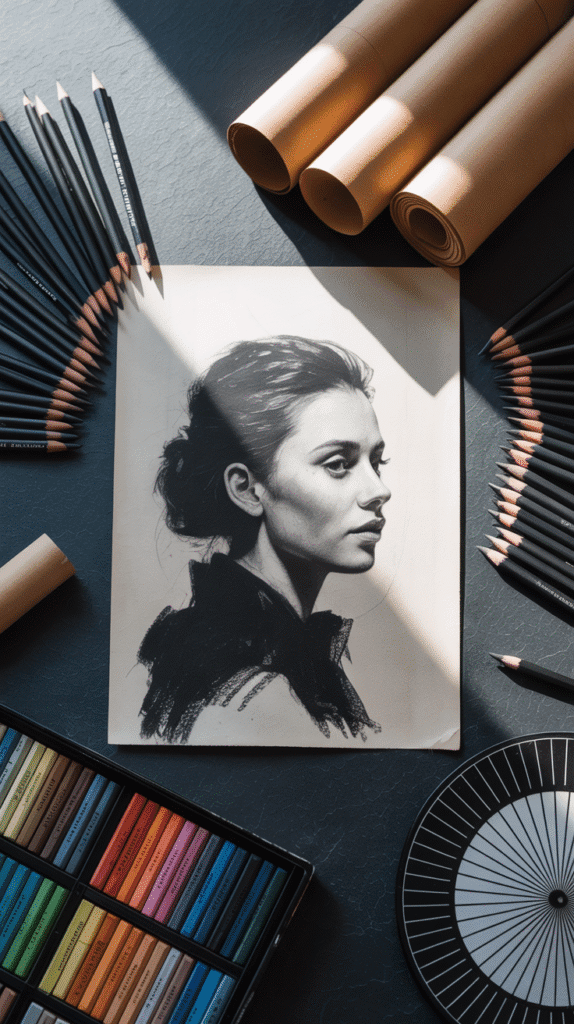
Here’s my take: with charcoal, the paper matters more than the charcoal. Charcoal is just dust. The paper’s tooth (its tiny hills and valleys) is what grabs that dust and holds it. Pick the right tooth for how you draw, and the same stick suddenly behaves.
New to charcoal? Start with the complete charcoal drawing resource hub, then come back here to pick your paper.
Quick answer: if you only do one thing
For a first serious charcoal paper, buy a pad of Canson Mi-Teintes in a mid-gray or tan. It has real tooth, holds up to blending, and the toned color lets you add white highlights. For super fine detail work with charcoal pencils, keep a smooth Bristol pad on the side.
What to look for in charcoal paper
Tooth
Tooth is the texture you feel when you run a finger across the sheet. More tooth holds more layers and deeper darks. Less tooth gives smoother blends and finer lines but fills up fast.
There are two textures you’ll see named on labels:
- Laid: fine parallel lines pressed into the sheet during manufacturing. The lines show through charcoal as a soft striped texture, which looks lovely in classic figure and portrait studies.
- Wove: an even, uniform surface with no pattern. More neutral, so your marks are the only texture.
Weight
Heavier paper handles erasing, blending and layering without pilling or tearing.
- Around 60 lb: fine for practice and quick studies.
- 90 lb (about 150 gsm) and up: better for finished drawings you’ll work over, erase and rework.
Cotton content
Cotton paper is softer and stronger, and it survives heavy erasing better than wood pulp paper. It also costs more. 100% cotton is the top tier.
Color: white vs toned
- White gives you the full range from paper white to deepest black. Great for high contrast.
- Toned (gray, tan, blue) gives you a free midtone. Draw your shadows in charcoal, your highlights in white charcoal or pastel pencil, and let the paper do the middle. Drawings come together much faster.
Acid-free
Look for “acid-free” if you plan to keep the drawing. Acidic paper yellows and turns brittle over the years.
Comparison table: 5 charcoal papers
Prices change, so use these as tiers: $ = budget, $$ = mid, $$$ = premium.
| Paper | Surface | Weight | Fiber | Color | Best for | Price |
|---|---|---|---|---|---|---|
| Strathmore 400 Series Artagain | Light tooth | 60 lb | Recycled | Toned colors | Practice and toned studies | $ |
| Canson Mi-Teintes | Honeycomb side + smoother side | 98 lb (160 gsm) | Check label | Many tones | Blending, toned drawings | $$ |
| Fabriano Tiziano | Soft, even tooth | 160 gsm | 40% cotton | Many tones | Layering with white highlights | $$ |
| Canson XL Bristol | Smooth, little tooth | 100 lb | Check label | White | Charcoal pencil detail, small work | $ |
| Legion Stonehenge | Smooth with gentle tooth | 90 lb (250 gsm) | 100% cotton | White plus colors | Finished, archival drawings | $$$ |
The 5 best papers for charcoal drawings
1. Strathmore 400 Series Artagain: best for practice on toned paper
Artagain is a recycled drawing paper in toned colors, around 60 lb. It’s light, so it won’t take heavy erasing, but it’s a joy for quick studies with charcoal and white highlights. The price makes it easy to fill pages without guilt.
Quick note so you don’t get confused at the store: Strathmore also makes a separate 400 Series Charcoal paper, a 64 lb laid paper. Different pad, different texture. Both are good for charcoal.
Coal Black Paper, Glue Bound, 6x9 inches, 24 Sheets (60lb/160g) - Artist Paper for Adults and Students - Pastel and Charcoal

Choose it if: you draw a lot and want toned paper that doesn’t feel precious.
2. Canson Mi-Teintes: best all-around for blending
Mi-Teintes is 98 lb (160 gsm) with two different sides. One has a honeycomb texture that shows through your charcoal as a subtle pattern. The other is smoother and better for even blends and fine detail. Try both on the same sheet before you commit.
Assorted Colors, Foldover Pad, 9x12 inches, 24 Sheets (98lb/160g) - Artist Paper for Adults and Students

Choose it if: you want one paper that does a bit of everything, especially on a toned ground.
3. Fabriano Tiziano: best for soft layering
Tiziano is 160 gsm with 40% cotton, which gives it a soft hand and good strength for building up layers. It’s beautiful with charcoal plus white chalk on a warm or gray tone.

Choose it if: you love the look of classic charcoal and white chalk studies.
4. Canson XL Bristol: best for fine detail
Bristol is 100 lb with a smooth surface and very little tooth. That means crisp lines and smooth gradients with charcoal pencils, but it fills up after a couple of layers and won’t hold heavy darks from a vine stick.
Smooth, Foldover Pad, 9x12 inches, 25 Sheets (100lb/260g) - Artist Paper for Adults and Students - Markers, Pen and Ink

Choose it if: you draw small, detailed work with charcoal pencils. Skip it for big, loose, smudgy drawings.
5. Legion Stonehenge: best for finished, archival work
Stonehenge is 100% cotton, 90 lb (250 gsm), soft and strong. It holds up to erasing and reworking, and it’s archival, so finished drawings stay white for decades.

Choose it if: you’re making drawings to frame, gift or sell.
Vine vs compressed charcoal: match the paper
- Vine and willow charcoal is light and powdery. It needs real tooth to grab onto, so laid paper, Mi-Teintes or Tiziano work best. On smooth Bristol it mostly slides around.
- Compressed charcoal is denser and darker, and it smears more. A cotton paper like Stonehenge holds those deep darks and lets you lift and erase without damaging the surface.
- Charcoal pencils are the most flexible. They work on everything, including smooth Bristol for detail.
For the full rundown on sticks and pencils, see the best charcoal drawing tools for artists.
The 5-minute test strip
Before you buy a stack of any paper, test one sheet. Cut a strip about 2 by 6 inches and do this:
- Make a patch of vine charcoal, a patch of compressed, and a line with a charcoal pencil.
- Blend half of each patch with a stump or tissue.
- Layer the compressed patch three times. Does it keep getting darker, or does it turn shiny and slick? Shiny means the tooth is full.
- Erase a corner of each patch with a kneaded eraser. Does it lift cleanly, or does the surface fuzz up?
- Add a stroke of white charcoal on top if it’s toned paper.
Label the strip with the paper name and keep it. A drawer full of test strips is the best paper guide you’ll ever own.
Pads vs full sheets
- Pads are perfect for practice, sketchbook-style studies and travel.
- Full sheets (usually around 19×25 or 22×30 inches, depending on the brand) are cheaper per square inch and let you draw big, which is where charcoal really shines.
Tips for better charcoal drawings on any paper
- Work light to dark. Start with vine charcoal and save compressed for the final darks. Once the tooth fills, it’s full.
- Use toned paper plus a white charcoal pencil for fast, dramatic drawings. Your paper is already the midtone.
- Spray workable fixative outdoors or in a very well ventilated space, in light coats from about 12 inches away. A few thin coats beat one heavy one.
- Keep a sheet of scrap paper under your hand so you don’t smudge finished areas.
- Blend with restraint. Over-blending flattens tooth and turns everything gray. See how to blend charcoal like a pro.
Investment pieces worth it
Once you’ve found your paper, these are the upgrades that protect the work and make the process nicer.
A flat file for finished drawings
Charcoal smudges if anything slides across it. Storing finished pieces flat, with a sheet of glassine on top, keeps them crisp.
- AdirOffice Flat File Cabinet, 5 drawers for 29×40 documents, about $735. Drawers fit full 22×30 sheets with room to spare.
Worth it for: artists working on full sheets and keeping a growing stack of finished drawings. $735 over 10 years is about $74 a year. Skip it if: you work mostly in pads. An acid-free portfolio under the bed protects a small collection for a fraction of the cost.
An air purifier for charcoal dust
Charcoal dust floats and settles on everything. A true HEPA purifier near your drawing table catches a lot of it.
- Levoit Core 400S-P air purifier, about $190.
Worth it for: anyone who draws with charcoal several times a week, especially in a small room. Skip it if: you draw near an open window or mostly use charcoal pencils, which make much less dust.
A drafting table
Drawing on a tilted surface lets the dust fall away from your paper instead of sitting on it, and your neck will thank you too.
- Studio Designs Vintage Drafting Table, solid wood, about $270.
Worth it for: anyone drawing at 18×24 or larger. Skip it if: you draw small on pads. A tabletop easel does the same tilt for much less.
The takeaway
Choose paper by tooth first: toothy and toned for blending and highlights, smooth Bristol for detail, 100% cotton for drawings you want to keep. Test a strip before you buy a stack, and work light to dark so the tooth lasts.
Which paper is your charcoal favorite, or are you still searching? Tell me in the comments.
Save this pin for your next paper order.
[…] you loved this guide, check out:➡️ The Best Paper for Charcoal Drawings➡️ How to Blend Charcoal Like a […]