This post contains affiliate links. If you buy through them, I may earn a small commission at no extra cost to you.
That faint wave across a fresh sheet of watercolor paper? The dent in a canvas you never touched? Those usually start with the air in the room, long before anything gets messy.
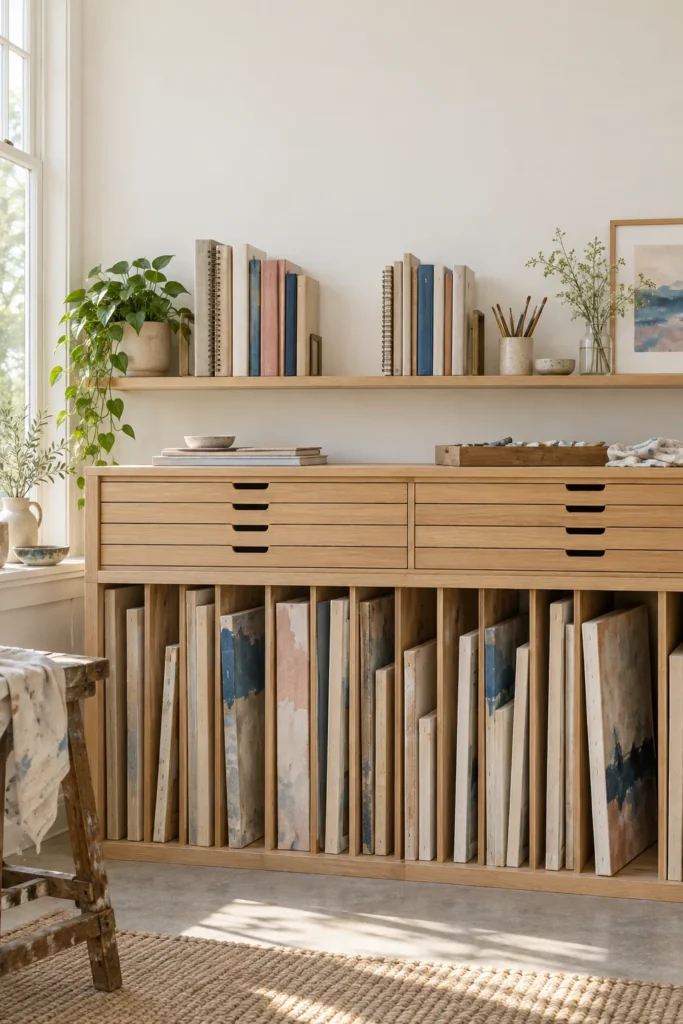
Here’s my take: storage is a climate problem first and a container problem second. The prettiest rack in the world won’t save paper that sits at 70% humidity in a closet against an outside wall. Get the room right, then pick the furniture.
Below: the numbers, the rules for each material, and the pieces worth paying for.
Quick answer: if you only do one thing
Put a $10-15 digital hygrometer in the spot where your paper lives. Aim for 40-50% relative humidity and a steady 65-72°F. If it reads above 60% for more than a few days, move the paper or add a dehumidifier before you buy any storage.
The numbers that protect your art
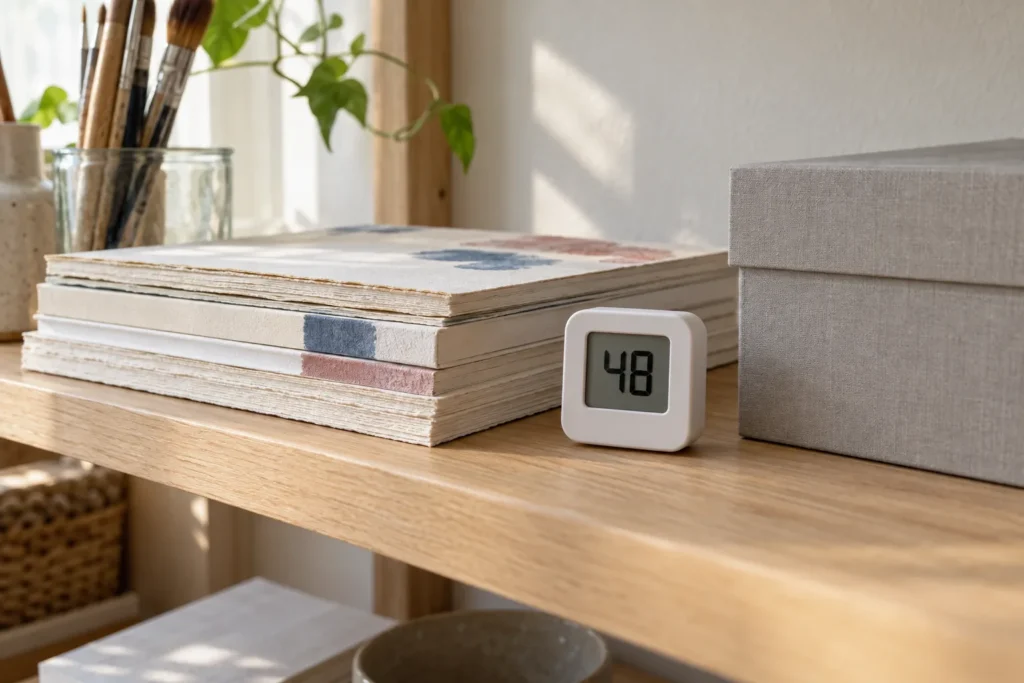
Paper and canvas are made from plant fibers, and plant fibers drink moisture from the air. That’s the whole story behind most storage damage.
- Relative humidity of 40-50% is the sweet spot. Paper stays flat, canvas stays taut, and glue bindings stay put.
- Above about 60%, paper fibers swell unevenly. That’s cockling (the rippled, wavy look) and buckling (when a sheet won’t lie flat anymore).
- Above about 65% for days at a time, mold can start to grow. Foxing, those small rusty-brown spots on old paper, also thrives in damp air.
- Below about 30%, paper turns brittle and canvas can tighten and crack paint on older pieces.
- Swings matter as much as the number. Paper that bounces between 35% and 65% every week expands and shrinks every week. Steady beats perfect.
Where to store (and where not to)
Good spots: an interior closet or a shelf on an inside wall of a heated, cooled room.
Skip attics, basements, garages, spots near a radiator and anything under a sunny window. That’s where humidity and temperature swing most.
Light and air
UV light yellows paper and fades pigments, even through a window. Keep paper and finished work out of direct sun.
Air should move a little. Sealed plastic bins can trap moisture inside, so if you use them, add a few silica gel packs and check the hygrometer reading in that room each season.
Acid-free or it doesn’t count
Regular cardboard, kraft paper and most cheap folders are acidic. Over time that acid migrates into your paper and turns edges yellow and brittle. For anything you want to keep, look for “acid-free,” “archival” or “lignin-free” on boxes, folders and interleaving sheets.
How to store canvas
Canvas is tough on the front and fragile on the back. Most damage happens when something presses into the back of the fabric and leaves a permanent dent or bulge.
Do this, not that
- Stand canvases upright on their stretcher-bar edges. The wooden frame takes the weight, and the fabric stays clear.
- Never stack canvases face-to-face or face-to-back without protection. The corner of one stretcher will dent the next canvas’s surface.
- Don’t lean a canvas on one corner. That twists the stretcher out of square over time.
- Sort by size, largest at the back. A small canvas leaning on a large one pushes into its fabric.
- Separate finished paintings with a sheet of acid-free board or glassine if they must touch. Wait until oil paintings are dry to the touch at minimum, and remember oils keep curing for months.
- Keep canvases 4 inches or more off the floor in case of a spill or a damp floor.
Vertical canvas racks
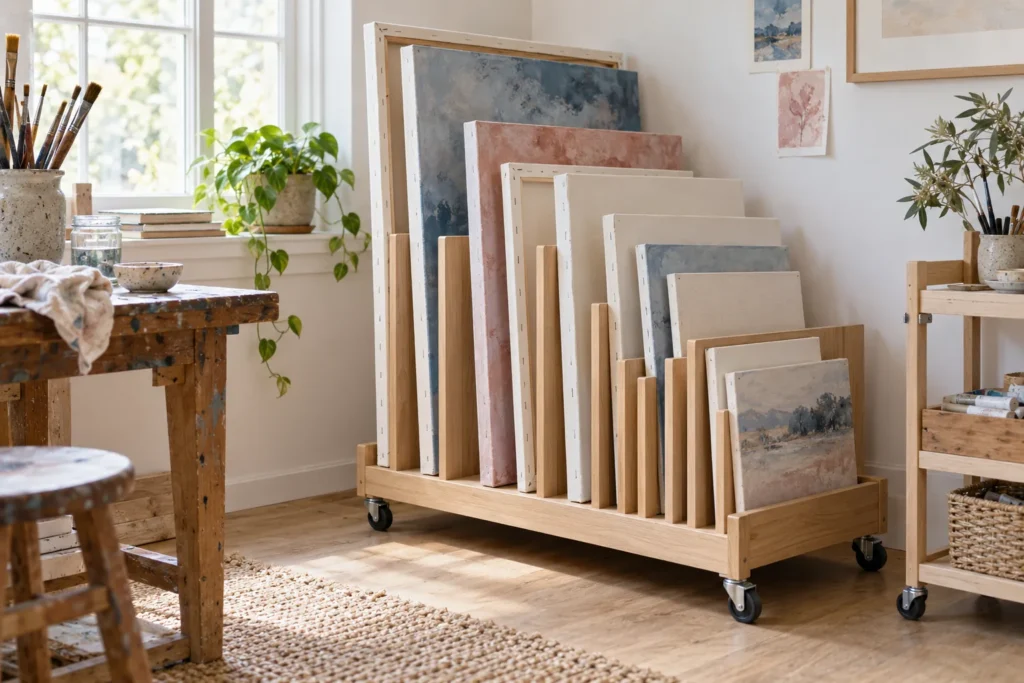
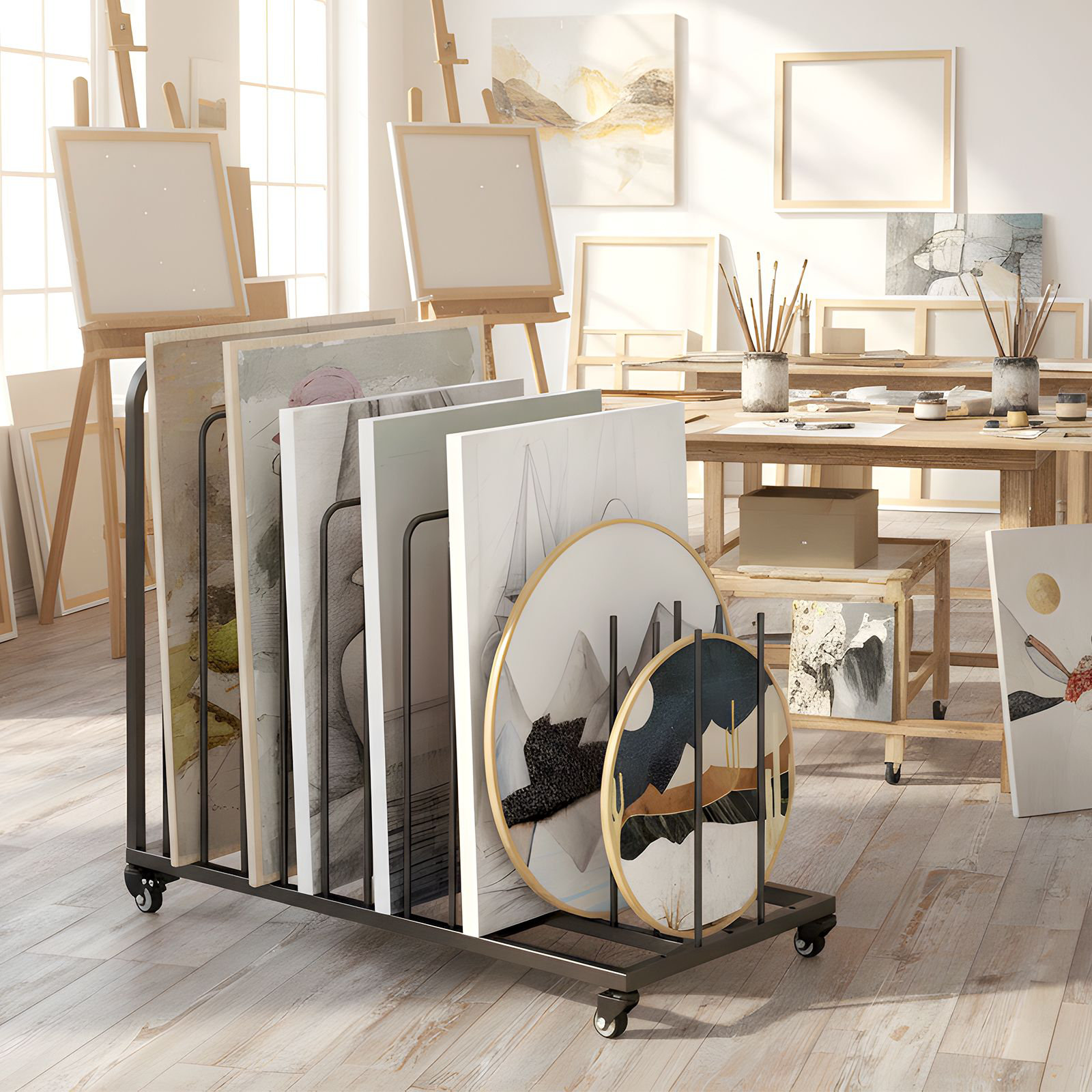
A slotted rack follows all of those rules at once: each canvas stands on its edges in its own slot, and you flip through them like records.
| 
| 
| 
|
N/A | $79.99
| $81.99
| $99.99
|
For a handful of small canvases (8×10 or 11×14), an upright file sorter on a shelf does the same job for much less.

Rolled canvas
If you paint on unstretched canvas or have to roll a finished piece to move it, roll it around a wide tube (4 inches or more across) with the painted side facing out, and slip a sheet of glassine over the paint first. Rolling paint-side in compresses the paint layer and makes cracking more likely. Store the roll horizontally, never standing on end.
How to store paper
Loose paper wants two things: to lie flat and to stay out of the air’s way.
Flat is the gold standard
Store paper flat, in a closed drawer or box, with a light, even weight on top. A sheet of acid-free mat board or a smooth drawing board on top of the stack keeps edges from curling in damp months.
- Shallow drawers win. Drawers 2-3 inches deep keep stacks short, so you don’t crush the bottom sheets or dig through 40 pieces to reach one.
- Keep the drawer bigger than the paper. A full sheet of watercolor paper is 22×30 inches, so a flat file with drawers around 29×40 inches holds full sheets with room to lift them out.
- Keep pads in their original covers and lay them flat with the heaviest at the bottom.
White Desktop Drawer Set with 10 Color Coded Draws - Letter Size Files - Perfect for Storing Documents and Paper Work

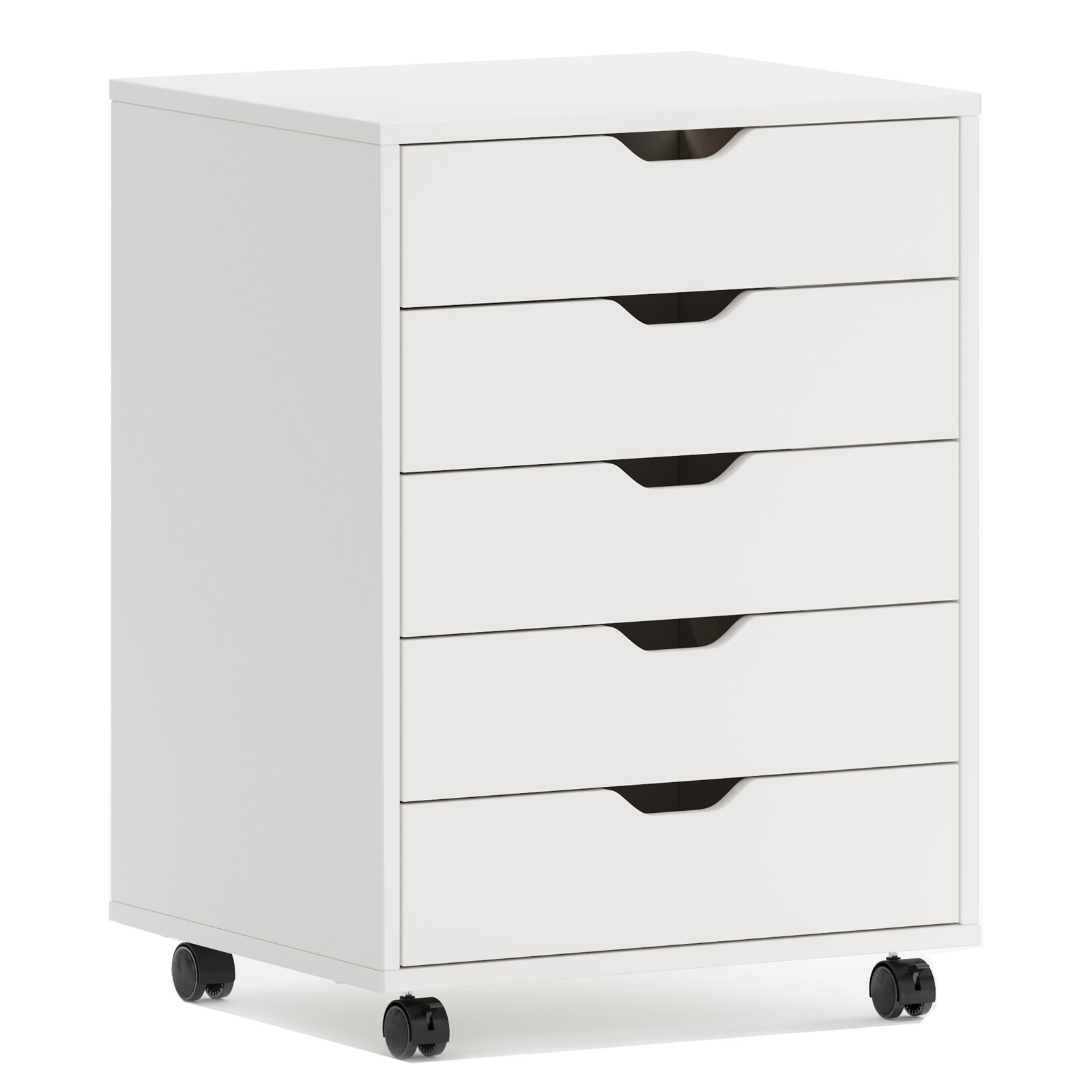
Choosing paper in the first place? See the best paper for charcoal drawings for which surfaces hold up best.
Vertical holders, for work in progress only
Upright holders are great for the sheets and pads you’re using this week. For long-term storage, sheets standing upright tend to slump and bow, so move them to flat storage once a project ends.
7 Slots Mail Paper Organizer Desk Sorter Holder for File Document Organizer Stand for Home Office Natural (7KWJJ-NA)

Finished drawings and pastels: glassine between every sheet
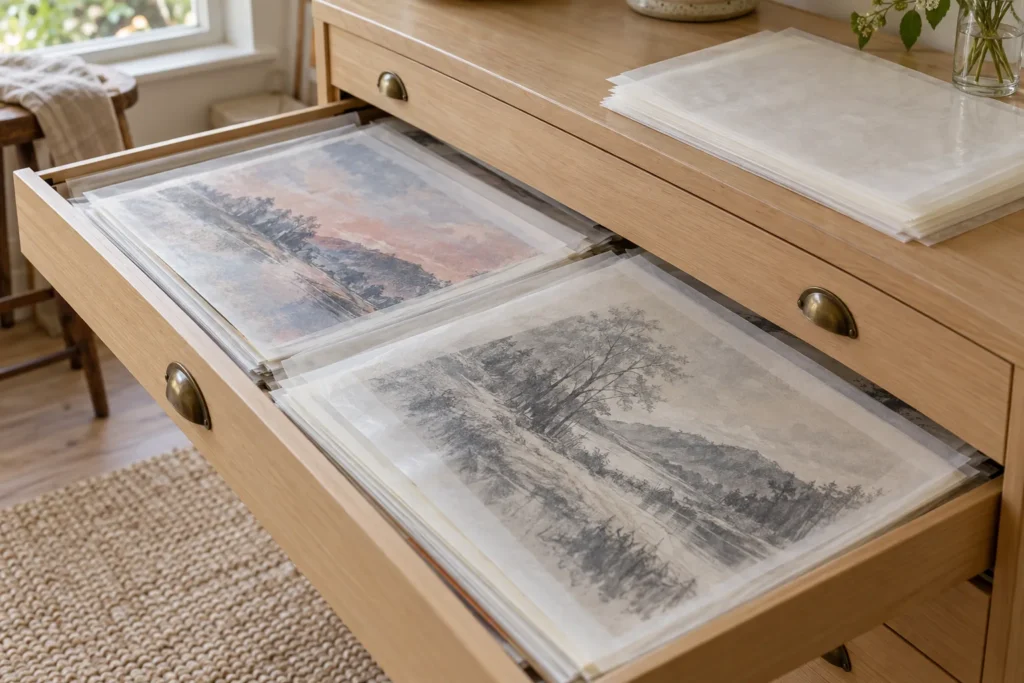
Glassine is a smooth, translucent, air-resistant paper that keeps graphite, charcoal and pastel from transferring onto the next sheet. For finished pieces:
- Fix charcoal and soft pastel with a workable fixative first if you’re comfortable with that, or simply handle them very gently.
- Lay a sheet of glassine (cut a few inches larger than the drawing) over each piece.
- Stack flat in an acid-free box or flat file drawer.
- Lift sheets straight up, never slide them. Sliding drags glassine across loose pigment and smears it.
A pack of glassine sheets costs about $15-25 and protects years of work. That’s the cheapest insurance in this whole guide.
How to store sketchbooks
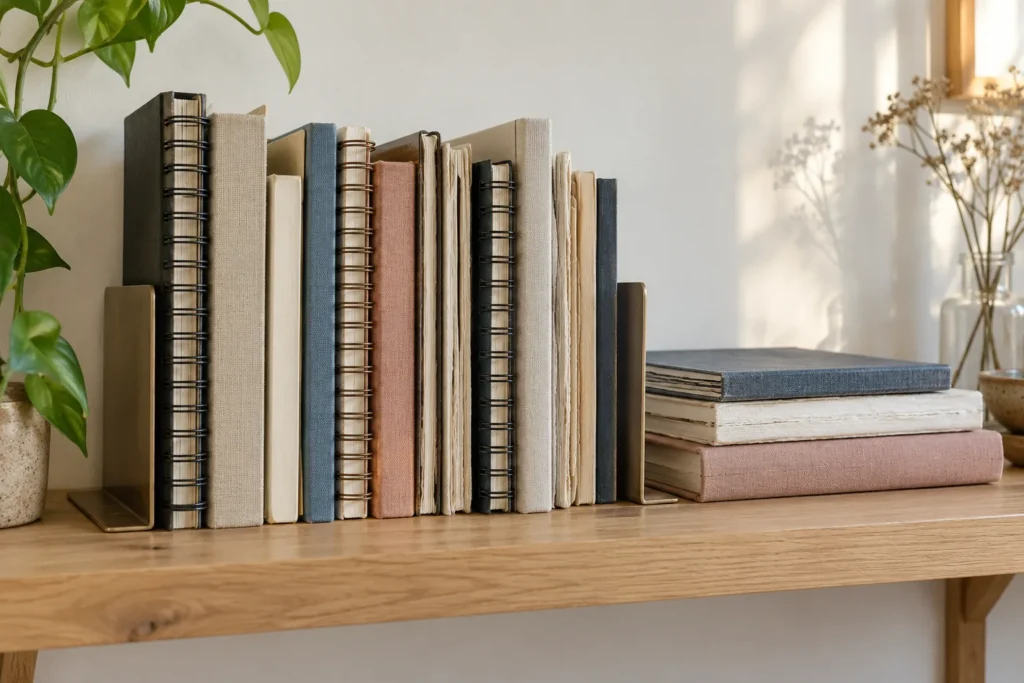
Sketchbooks are books, so store them like books.
- Upright on a shelf, spine out. Label the spine with the date range so you can find a year at a glance.
- Use bookends. A half-empty shelf lets sketchbooks lean and slump, which warps the covers and strains the binding.
- Don’t pack them in too tight, either. You should be able to slide one out with two fingers. Jamming them in scuffs covers and traps moisture.
- Lay oversized books flat. Anything taller than about 14 inches, or any book with a soft cover, is happier lying flat in a stack of no more than 5.
- Let a wet-media sketchbook dry open before shelving it. Watercolor pages closed while damp can stick and cockle.
Overflow and bins
For older sketchbooks you don’t open often, an open crate or basket on a low shelf keeps them upright and breathing. Choose open-weave or open-top over sealed plastic.
Rattan Vinyl Record Holder with Handle, Wood Record Crate for Vinyls Holder up to 75 LP's, Desktop Cube Album Storage for Vinyls Records(Tea Brown)

 StorageWorks Wicker Basket
 Baskets for Organizing, Storage Basket with Built-in Handles, Water Hyacinth Shelves (Medium 2-Pack, Natural Hyacinth)
Small-space tricks
- Use the space under the bed for flat paper storage in an acid-free box. It’s dark, it’s on an interior floor, and it’s out of the way.
- Slide a canvas rack into the gap beside a dresser or bookcase. Many are under 15 inches wide.
- Keep one “active” holder on the desk and everything else in long-term storage.
Save your back: heavy paper stacks and big flat file drawers are lifted from the floor more than people expect. Keep the heaviest storage between hip and shoulder height when you can, and bend at the knees for the lowest drawer.
Investment pieces worth it
You’ve gotten the free fixes. Here’s where spending more actually changes the result.
A real flat file
This is the piece that makes paper storage almost automatic: wide, shallow drawers that keep full sheets flat, dark and dust-free.
- AdirOffice 5-Drawer Flat File Cabinet, about $735. Drawers fit 29×40 inch sheets, which covers full sheets of watercolor and drawing paper. The value pick.
- Diversified Spaces Large Format File Cabinet, about $1,340. Light hardwood, so it reads as furniture in a living space instead of office equipment.
- Safco 5-Drawer Flat File, about $1,670. Holds 30×42 inch documents, the kind of steel flat file you see in architecture and design studios.
Worth it for: anyone with a growing stack of finished drawings, watercolors or full-size paper. $735 spread over 10 years is about $74 a year, less than replacing a few ruined sheets of good paper. Skip it if: you mostly work in pads and sketchbooks, or you have fewer than about 30 loose sheets. An acid-free box under the bed does that job for under $40.
A large rolling canvas rack
If canvases are leaning against your walls right now, a dedicated rack pays for itself in dents avoided.
- Art Storage Rack with handle and casters, about $155. Rolls out of a closet, keeps canvases on their edges in separate slots.
- Extra-large wooden adjustable art drying and storage rack, about $160. Adjustable dividers handle a mix of sizes, and it doubles as a drying rack for wet work.
Worth it for: painters who finish more than one canvas a month or work bigger than 24×36. Skip it if: you own fewer than 10 canvases. A slotted file sorter or two on a sturdy shelf covers you.
An air purifier, if dust is your issue
Dust settles on paper and grinds into pastel surfaces. If your studio shares space with pets or carpet, a true HEPA purifier cuts down how much lands on your work.
- Levoit Core 400S-P air purifier, about $190.
Worth it for: pastel and charcoal artists, and anyone storing open work in a room with pets or carpet. Skip it if: your paper already lives in closed drawers and your canvases are covered. Keep the money for the flat file.
Seasonal storage check (15 minutes)
Do this when the heat or air conditioning switches on or off, since that’s when humidity shifts most.
- Check the hygrometer and note the reading.
- Open each flat drawer and look for curling edges, brown spots or a musty smell.
- Swap out silica gel packs in any closed bins.
- Turn canvases in the rack and check the backs for dents or slack fabric.
- Pull one sketchbook from each shelf and make sure the covers aren’t bowing.
The takeaway
Fix the air before you buy furniture: 40-50% humidity, steady temperatures, no direct sun. Then store canvas on its edges, paper flat under a light weight, finished drawings in glassine, and sketchbooks upright with bookends.
What’s the hardest thing in your studio to store right now: big canvases, loose paper or a shelf full of sketchbooks? Tell me in the comments.
Save this pin for the next time you’re tempted to buy another plastic bin.
[…] → How to Organize Your Brushes, Pens & Tools → How to Store Canvas, Paper & Sketchbooks […]