This post contains affiliate links. If you buy through them, I may earn a small commission at no extra cost to you.
Ever started a watercolor, needed your laptop for a reference photo, and ended up with a wet palette balanced on your keyboard? An L-shaped desk fixes that, but only if you set up the corner on purpose.
Here’s my take: an L-shaped desk is really two desks that share a corner, and the corner is where most people waste it. They pile mail there, or shove the monitor into it, and lose the best real estate in the room. Give each arm of the L one job, keep the corner for your light and your daily supplies, and suddenly a 60-inch desk works harder than a 100-inch table.
If you only do one thing: put screens on one arm of the L and paper on the other. Never let them share a side. Your sketchbook stays dry, your tablet stays clean, and switching tasks is a simple swivel.
Why artists love the L shape
A straight desk makes you choose: computer in the middle, or artwork in the middle. An L gives you both without clearing the surface every time you switch.
- Two clean zones. One for digital work, one for drawing or painting.
- A corner that’s actually useful. Lamp, brush jar, and pencil cup within reach of both sides.
- More surface in the same footprint. A 60 x 60 inch L fits into a corner that would never take a 120-inch straight table.
- Room to spread out. Reference photos on one side, the drawing on the other, and nothing stacked on top of anything.
Which side should be the return?
The “return” is the shorter arm of the L. Most desks are reversible or come in left and right versions, so decide this before you buy.
My rule of thumb: put the digital zone on the long side and your traditional work on the return. Monitors and keyboards need width. A drawing pad needs depth and good light more than it needs length.
Then think about your light. Right-handed artists want the lamp (and ideally the window) on their left so their hand never shadows the pencil. Lefties, flip that. If your window is on the left wall, a right-hand return lets you face it while you draw.
Measure your corner first
L-shaped desks are big, and returning one is a project nobody enjoys. Five minutes with a tape measure saves you a lot of grief.
Use these common sizes as a starting point, then check the exact dimensions on the listing you’re considering.
| Desk size | Min. wall lengths | Best for |
|---|---|---|
| 55 x 40 in | about 58 x 43 in | Small rooms, sketching plus laptop |
| 60 x 60 in | about 63 x 63 in | Most home studios |
| 66 x 48 in | about 69 x 51 in | Painters who want a long main side |
| 83 x 60 in | about 86 x 63 in | Big paper, two monitors, the works |
Desk depth matters more than length. Aim for at least 24 inches of depth on the drawing side so your forearm can rest in front of the paper. On the monitor side, 24 inches is the bare minimum for one screen at arm’s length.
8 L-shaped desk styles (and the best pick for each)
1. Minimalist L with drawers
Clean lines, a light surface, and a couple of drawers for pencils and erasers. If you like an uncluttered look, this is the easy choice.
59 inch Corner Desk with Shelves, Reversible L-Shaped Office Desk Study Writing Table Workstation for Home Office, White

2. Corner desk with open shelves
Open shelves keep sketchbooks, reference books, and jars of brushes on display. Great for visual people who forget what they own once it’s behind a door.
Reversible Corner Computer Desk or 2 Person Long Table for Home Office Large Gaming Writing Storage Workstation P2 Board with 3 Cable Holes, Oak

3. L-shaped desk with drawers and cabinets
If your supplies tend to wander, closed storage is your friend. Shallow drawers hold pens and tubes; a cabinet hides paper packs and the half-finished things you’re not ready to look at.
Office Desk with File Cabinet Storage, Cable Management, Keyboard Tray, in Vintage Oak Finish

4. Standing L-shaped desk
Raise it to sketch standing up, lower it for long digital sessions. Many artists find switching positions through the day keeps their energy up.
63 x 48inch Large with Drawers | Reversible Tabletop, 2 Memory Height Settings | Home Office & Gaming Height-Adjustable Table, Light Walnut Top/White Frame

If you prefer a farmhouse look, the Latitude Run L-shaped electric standing desk brings warm wood tones to a sit-stand setup.
5. Industrial L
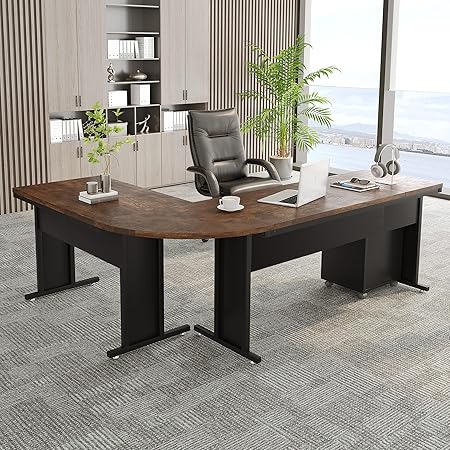
Metal frame, wood-look top, and a sturdy stance that doesn’t mind a heavy gel medium jar or a glue gun. It suits lofts and studios with exposed brick or black metal accents.
Large Office Desk with Drawers, Industrial Corner Computer Table with Rolling File Cabinet, Business Workstation for Home Office (Brown, 83 Inches)
6. Reversible L
Not sure which way your room will work next year? A reversible desk lets you flip the return to either side, which is handy if you move or rearrange often.
Corner Computer Desk, Sturdy Home Office Computer Table, Writing Workstation, Vintage

7. Extra-wide L with a file cabinet
Long arms, lots of surface, and a built-in cabinet for paper and portfolios. This is the one for mixed media artists who always have three projects going.
Large Home Office Computer Desk with Storage Shelves and Cabinet, Modern Business Furniture Set Home Office, Walnut White

For a more streamlined look with a matching cabinet and wardrobe, see the Bush Vista L-shaped desk with metal legs.
8. L with a hutch
A hutch adds vertical storage right above your work. Perfect for small rooms where wall space is precious and floor space is gone.
Corner Desk with Storage for Home Office in Linen White Oak, 60W L Shaped Computer Desk

L-shaped desk or straight desk plus a cart?
An L isn’t the answer for every room. Sometimes a straight desk and a rolling cart do the same job for less.
- two fixed zones
- uses a dead corner
- big footprint
- harder to move
- one zone at a time
- fits any wall
- cart rolls away
- easier to move
Pick the L if you switch between screen and paper several times a day. Pick the straight desk and cart if you mostly do one thing per session, or if your room doesn’t have a free corner. My best rolling art carts roundup has the ones I’d look at.
Choose by your medium
| Medium | Long side | Return | Must-have feature |
|---|---|---|---|
| Digital art | Monitor and tablet | Sketching pad | Cable tray, 60 in or wider |
| Painting | Laptop for references | Palette and paper | Wipeable top |
| Mixed media | Cutting mat | Drying space | Heavy-duty frame |
| Small spaces | Laptop and sketchbook | Storage | Hutch or shelves |
Digital artists: prioritize width and cable management. Two monitors plus a pen display need at least 60 inches on the long side.
Painters: a wipeable surface is non-negotiable. Laminate and metal tops forgive the occasional knocked-over water jar far better than raw wood.
Mixed media artists: go heavy. A wobbly desk and a craft knife are not friends.
Small spaces: look at a 55-inch L with a hutch, or a reversible model you can flip when the furniture shuffles.
Investment pieces worth it
Everything above works. These two are for artists who know they’ll be at this desk for years and want furniture that feels like a keeper.
Sauder Palladia L-shaped desk. Around $680, with a mix of file drawers, small drawers, and a sturdy, furniture-grade look. Spread over five years of near-daily use, that’s about 37 cents a day. Worth it if you want closed storage and a desk that looks great in a living space. Skip it if you move often; it’s heavy and takes real time to assemble.
Sauder Harbor View Corner Desk in Salt Oak. The Sauder Harbor View Corner Desk runs around $460 and has a soft cottage feel with a light, warm finish. Worth it if your studio leans cozy, vintage, or coastal and you want the desk to be part of the decor. Skip it if you need a huge drawing surface; it’s better for sketching and a laptop than big paper.
Styling your L-shaped desk
Once the zones are set, make it a corner you want to sit in.
- Floating shelves above the short side. Keep the space above the return for jars and inspiration, and leave your eyeline over the drawing clear. My best shelves for art studios has options.
- A pegboard above the digital side. Hang headphones, rulers, and stylus holders right where you need them.
- Warm light for the room, daylight for the work. A 5000K, 90+ CRI lamp in the corner for color, and a cozy lamp elsewhere for the evening.
- A rolling cart by the long side. Today’s supplies roll in; when you’re done, they roll out.
- Keep one side clear. One empty surface invites you to start something new.
Want the full measurement plan for your chair, monitor, and lamp? Read how to choose the perfect desk setup before you assemble anything.
The takeaway
The best L-shaped desk for creative work is the one that fits your corner with room to push your chair back, and gives screens and paper their own arms. Measure first, decide which side is your return, and keep the corner for the things both zones share.
Which side would you make your drawing side, left or right? Tell me in the comments, and save this pin for the day you finally claim that empty corner.
[…] Best L-Shaped Desks for Creative Work […]