This post contains affiliate links. If you buy through them, I may earn a small commission at no extra cost to you.
That drawer you avoid opening, the one where tubes, pencils and a roll of tape have fused into a single mystery layer? You don’t need more willpower to fix it. You need a tape measure.
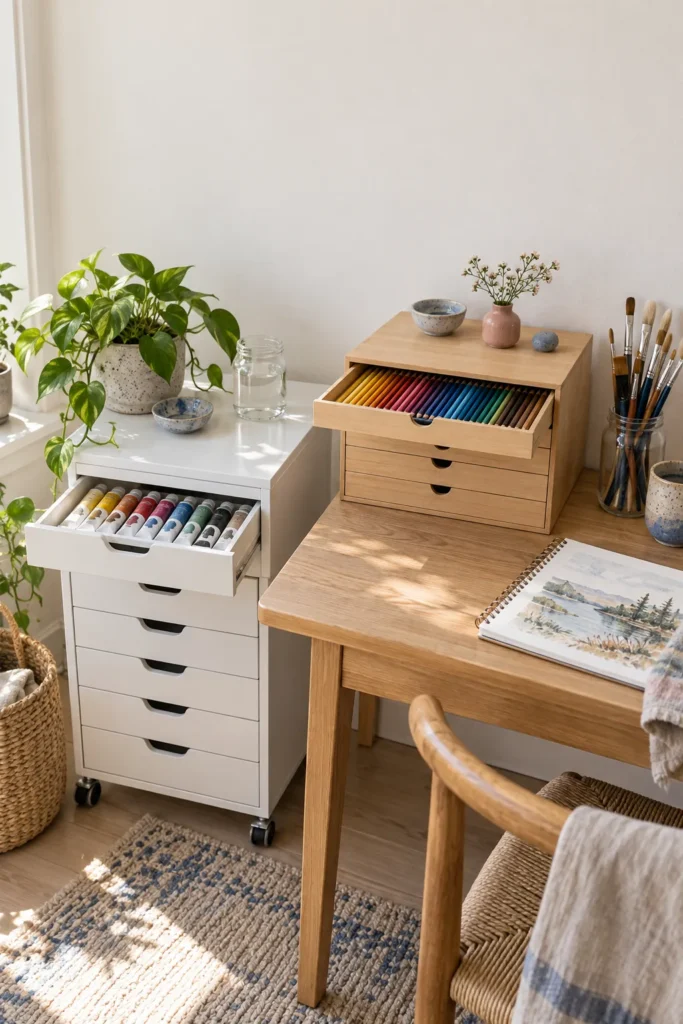
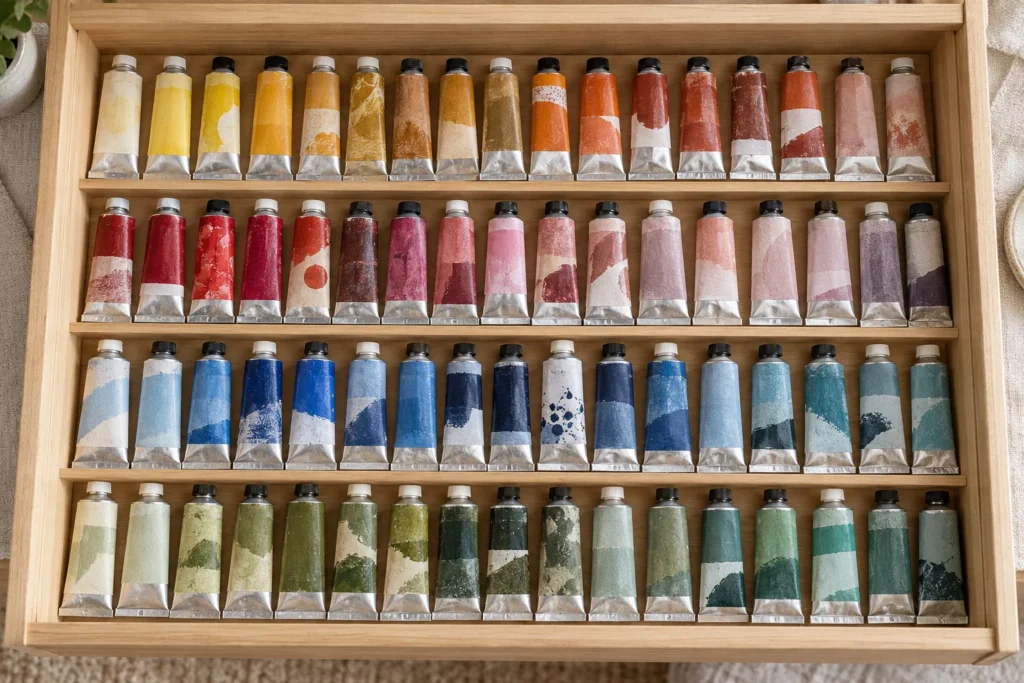
Here’s my take: most studio clutter is a drawer-depth problem. Paint tubes, pencils, markers and pastels all want drawers 2 to 3 inches deep, where everything sits in one layer you can see at a glance. Give those same supplies a 6 inch drawer and they stack, slide and disappear. Deep drawers become junk piles. Shallow drawers become systems.
Below you’ll find the best drawer units for artists at every budget, plus a depth guide so you buy the right unit the first time.
If you only do one thing: measure the tallest item you plan to store in a drawer and add half an inch. That number is your ideal drawer depth. Anything more than double it will turn into a pile.
Quick Picks: The Best Drawer Units for Artists
Best Overall: DEVAISE 7-Drawer Chest
Seven drawers in a slim, wood-look cabinet on wheels, at around $100. The drawers are shallow enough for pencils, markers and tubes in a single layer, and the white finish blends into a bedroom or living room corner. It rolls under or beside a desk, so your supplies come to you.

Best Budget: Seville Classics 10-Drawer Rolling Cart
Ten colorful, shallow drawers for about $60. It’s the easiest way to give every supply category its own home without spending much. Assign one drawer per category and label the fronts.
for Home Office, School, Classroom, Scrapbook, Hobby, Craft, 10 Drawer, Frost White

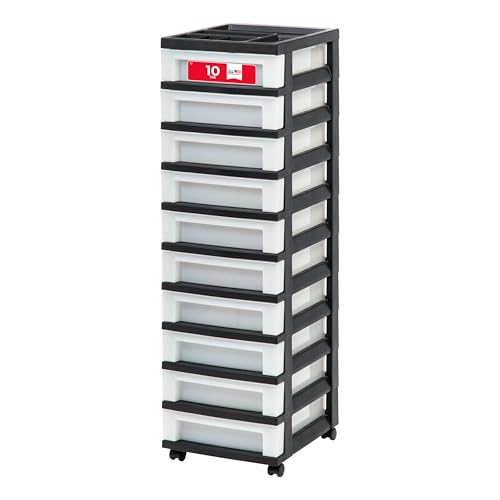
Best for Small Studios: IRIS USA Rolling Drawer Cart
A compact plastic cart on casters for around $68. It tucks beside a desk in a bedroom studio and rolls into a closet when you need the room back.
10-Drawers, for Classroom Art Craft Supplies Dresser Closet Bathroom Laundry Room, Black/Pearl
Best for Large Collections: Seville Classics 15-Drawer Cart
Fifteen drawers for about $85 means you can split paints by medium, pencils by brand, and still have drawers left for tools. It’s a strong pick if your supplies have outgrown one cart.
for Home Office, School, Classroom, Scrapbook, Hobby, Craft, 15 Drawer, White

Best for Paper (Pro Pick): Diversified Spaces Flat Paper Storage Cabinet
This is the serious one, at around $3,600. It’s a classroom-grade flat paper cabinet built to hold large sheets perfectly flat in shallow drawers, for years. It’s worth it for working artists, teachers and printmakers with a big paper inventory. If you store fewer than a few hundred sheets, skip it and look at the flat files in the investment section below.
48"W x 30"D x 84"H, Maple Construction, 2 Adjustable Shelves (1 Fixed), 7 Drawers, Locking Double Doors, Chemical Resistant Fini...

Best Overall
|
Best Budget Pick
|
Best for Small Spaces
|
Best for Large Supply Collections
|
Best for Paper Storage (Professional Pick)
|
$89.99
| $59.40
| $79.99
| $84.99
| $2,527.46
|
Match the Drawer to the Supply: A Depth Guide
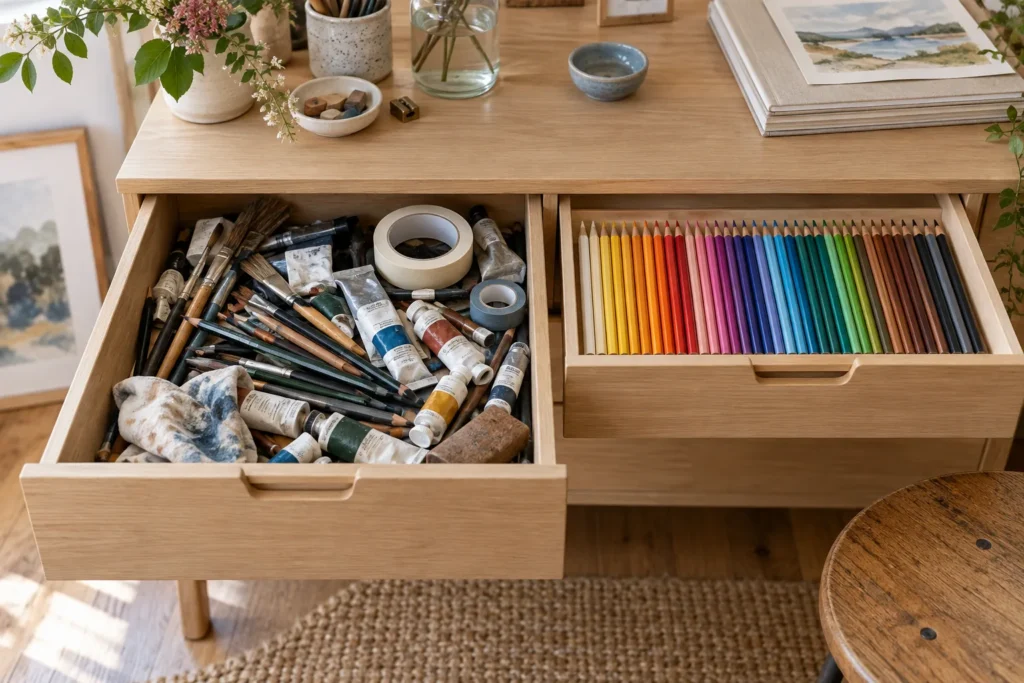
Most buying guides skip this part, yet it decides whether a drawer unit works for you. These are interior depths, from the drawer floor to the underside of the drawer above.
| Supply | Ideal drawer depth | Why |
|---|---|---|
| Colored pencils, graphite, charcoal sticks | 1.5 to 2 inches | One layer, every color visible |
| Markers and brush pens | 1.5 to 2 inches | Alcohol markers should lie flat anyway |
| Paint tubes (oil, acrylic, gouache) | 2 to 3 inches | Tubes lie flat in rows, labels up |
| Soft pastels and oil pastels | 2 inches | Keep them in their trays so they don’t rub |
| Watercolor pans and travel palettes | 1.5 to 2 inches | Palettes stay level so pans don’t pop |
| Brushes (stored flat) | 2 inches | Bristles stay untouched by other tools |
| Paper and prints | 2 inches, with a footprint 2 to 3 inches larger than your largest sheet | Flat storage, no curling or bent corners |
| Acrylic bottles stored upright | 6 to 7 inches | Most 4 oz bottles stand around 5 to 6 inches tall |
| Gesso, mediums, jars | 8 to 12 inches | Tall containers only; nothing small goes here |
Notice the pattern. Almost everything an artist owns wants a drawer under 3 inches deep. Deep drawers belong to a short list: tall bottles, jars and bulk refills.
A comfort rule I swear by: put your most-used shallow drawers between hip and shoulder height. Every daily trip to a bottom drawer is a bend, and a hundred bends a week adds up in your lower back.
The Six Types of Drawer Units (and Who Each One Suits)
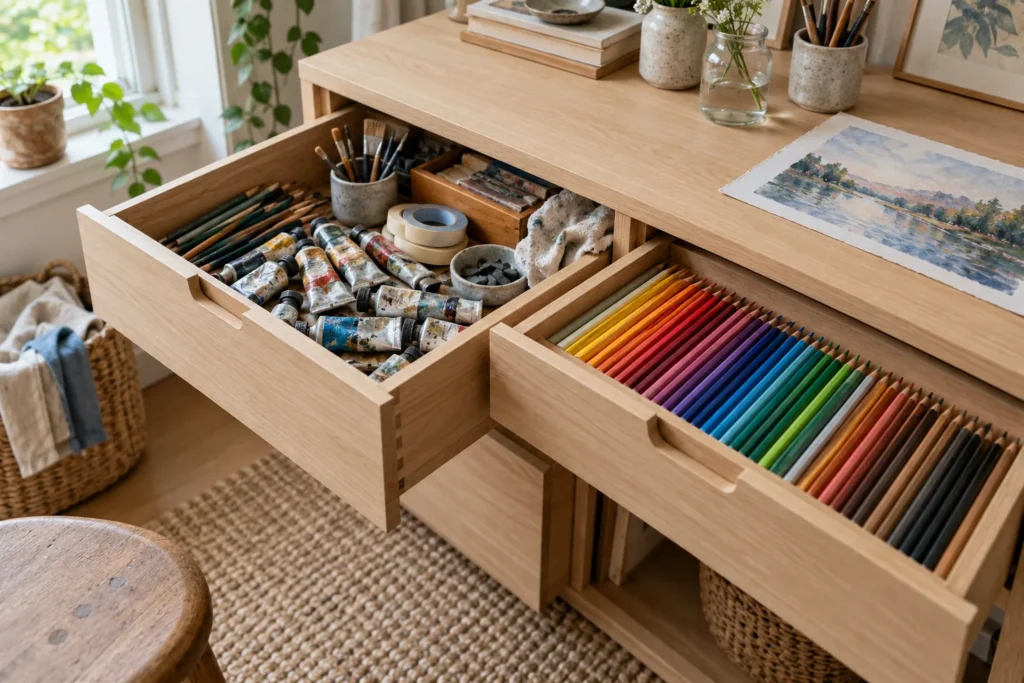
1. Shallow Wood Drawer Boxes
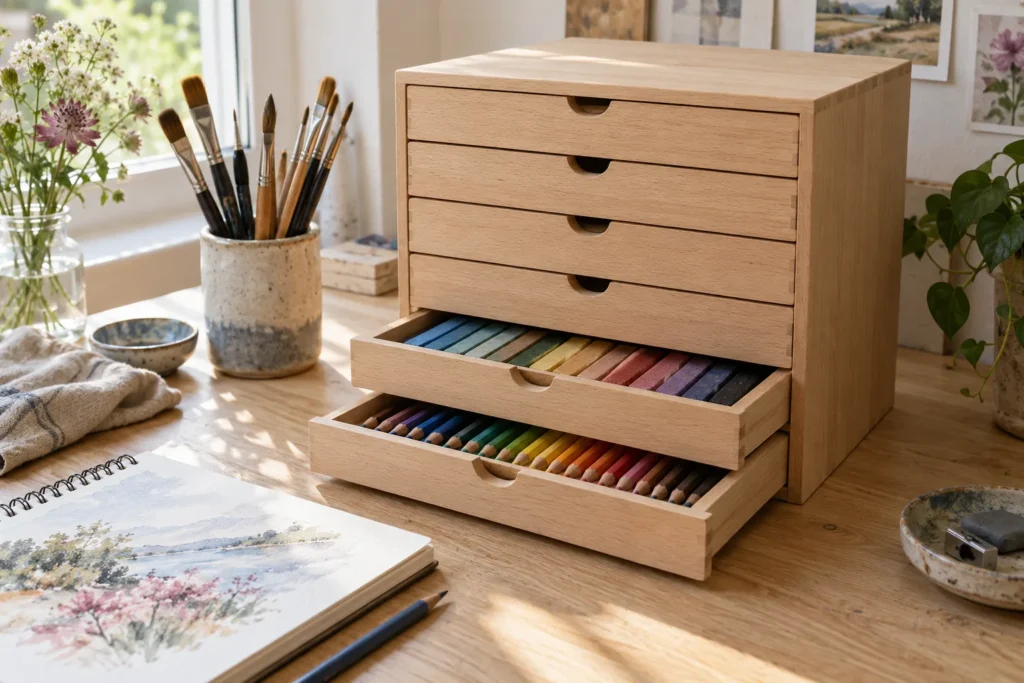
These are the classic artist’s chests: wide, shallow drawers in solid wood, sized for pencils, pastels and tubes. They sit on a desk or shelf and look good doing it.
My favorite here is the 7 Elements 6 Drawer Beechwood Art Supply Storage Box. Six shallow beech drawers keep a full pencil or tube collection sorted in single layers, and it looks like a piece of furniture instead of a storage bin. It’s a great fit for colored pencil artists and anyone who wants a desk that looks as calm as it works. Read my full review of the 7 Elements beechwood box.
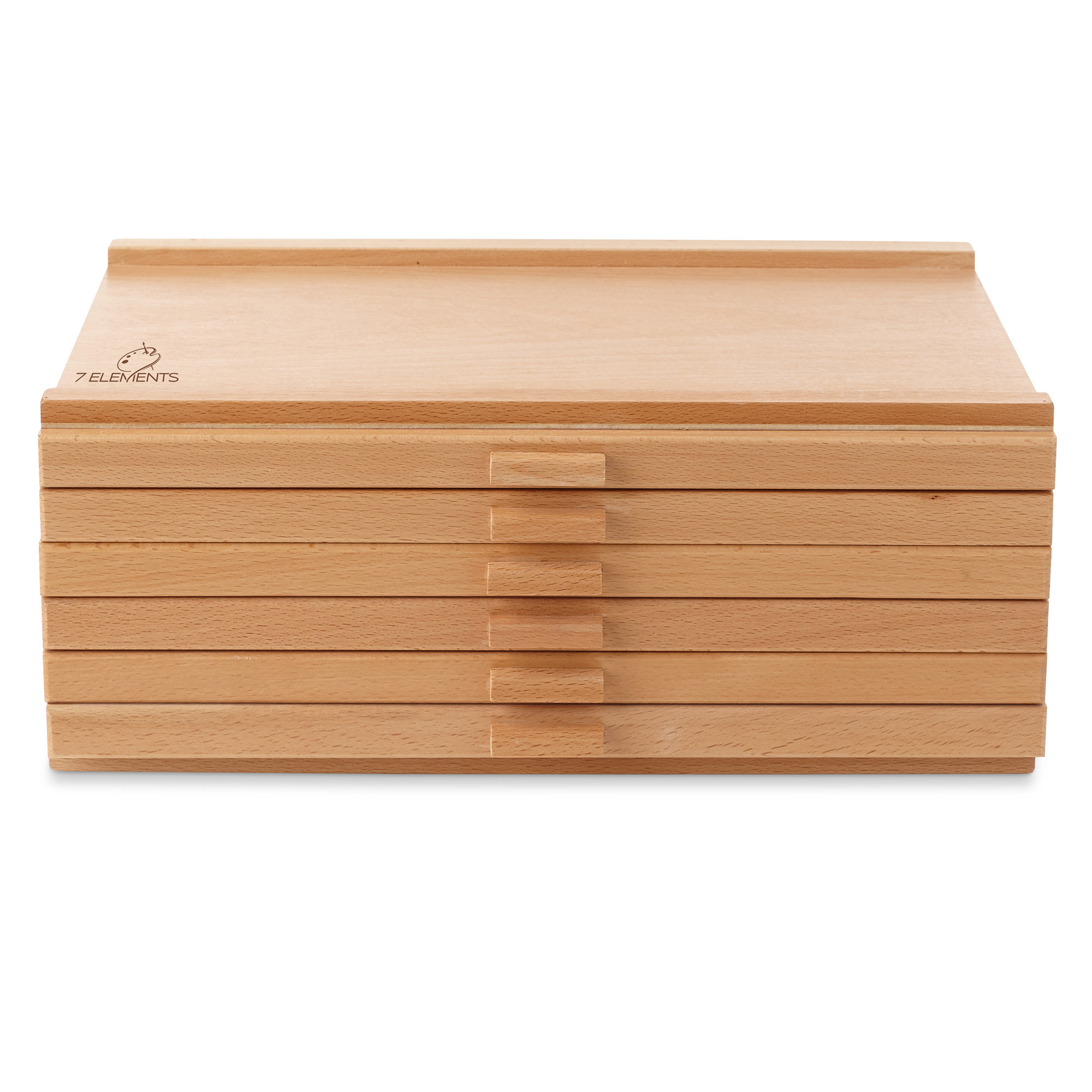
Best for: pencils, pastels, tubes, markers. Skip if: most of your supplies are tall bottles.
2. Wide Multi-Drawer Craft Units
A dozen or more drawers in one footprint, usually on wheels. They’re ideal if you work in several mediums and want each one separate. The KINGRACK cart adds a wooden top you can use as a small work surface. See the KINGRACK 12-drawer cart.
Mobile Craft Storage & Art Supply Organizer, Rolling Cart for Home Office, Classroom Storage with Wheels & Reviews | Wayfair
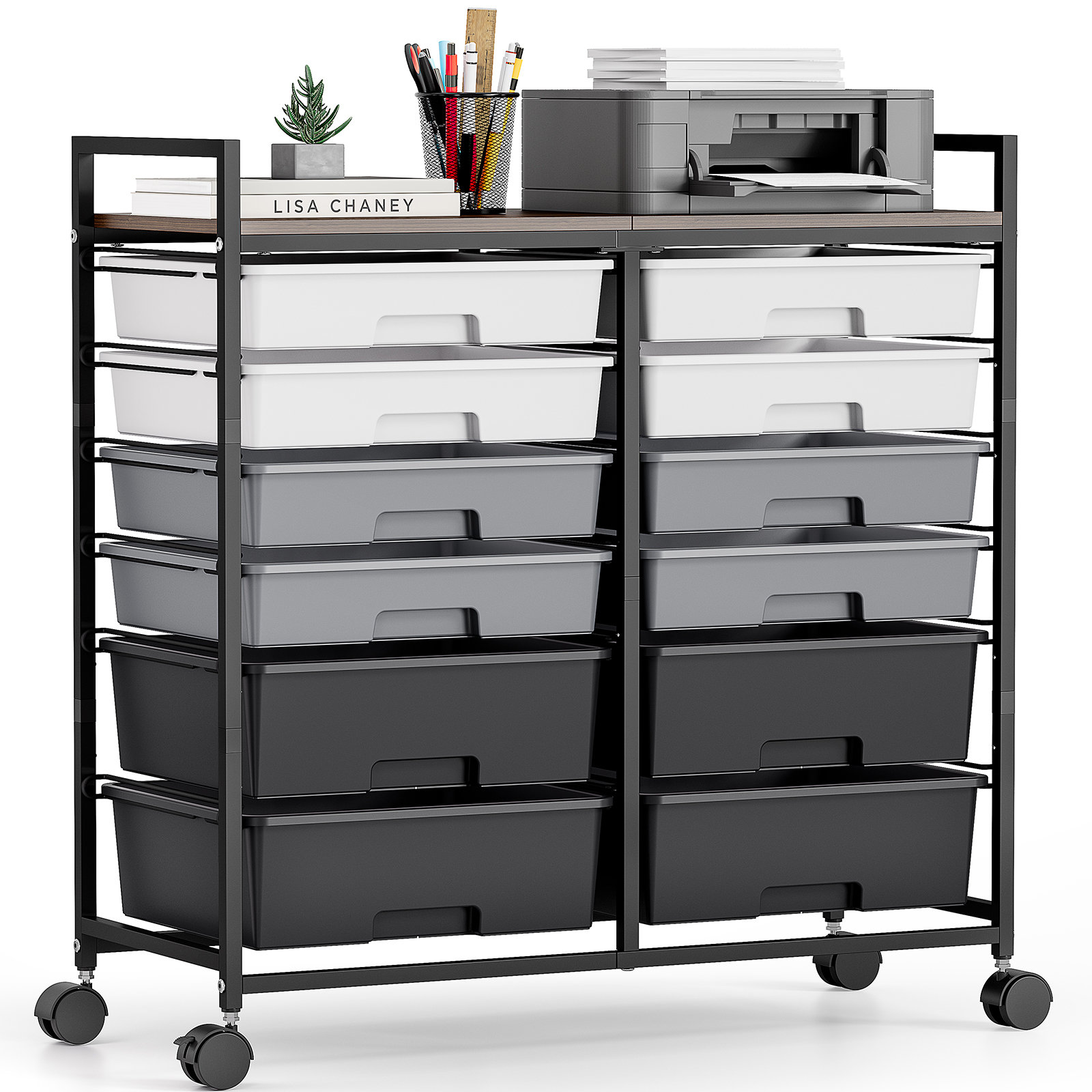
Best for: mixed-media artists. Skip if: you only use one or two mediums; you’ll end up with empty drawers that collect random things.
3. Clear Acrylic Drawers
Clear drawers let you see your supplies before you open anything, which is why they work so well for markers and small tools. A stackable set of three lets you start small and add more later.

Best for: visual thinkers, small tools, markers. Skip if: your desk sits in direct sun; light-sensitive supplies like some markers and pastels fade faster behind clear sides.
4. Rolling Drawer Carts
Carts are the workhorses. Roll one to the easel, roll it back when you’re done. A 20-drawer cart gives you enough slots to sort tubes by color family. See the Rebrilliant 20-drawer cart.

A simple layout that works: pencils and pens in the top drawers, paints in the middle, tools and refills at the bottom. Lightest and most-used on top.
Best for: painters who move between a desk and an easel. Skip if: you have thick carpet; casters fight it.
5. Flat File Drawers
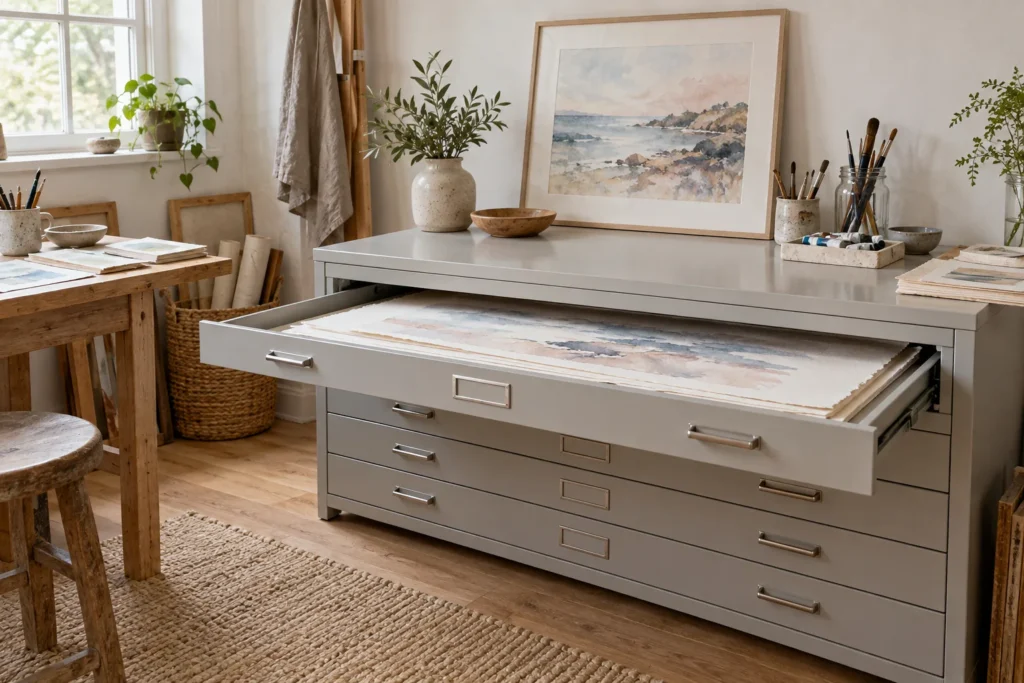
Real flat files have drawers about 2 inches deep and wide enough for full sheets of paper, prints and finished work. They’re the gold standard for anyone who works on paper larger than a sketchbook. Many sold as “file cabinets” online are really narrow makeup or office drawers, so check the interior drawer width before you buy. You want at least 2 to 3 inches more than your largest sheet. The investment section below covers three real flat files at three price points.
Best for: watercolor, printmaking, illustration, finished work. Skip if: you mostly work in sketchbooks; a bookshelf does the job for free.
6. Budget Plastic Drawer Carts
A 3-drawer plastic cart is often the smartest first purchase. It costs little, shows you how you actually use storage, and moves to the laundry room or garage later if you upgrade. See budget-friendly rolling carts.
Best for: new artists and first studios. Skip if: you want your space to look finished; these read as utility storage.
Investment Pieces Worth It
If you’re ready to buy storage once and keep it for a decade, these are the pieces I’d look at, with who each one suits and who should keep their money.
The cost-per-use math: a $275 steel cabinet used 4 days a week for 5 years works out to about 26 cents a session. A $60 cart that cracks in 18 months and gets replaced twice costs more than you’d think.
Bisley Steel MultiDrawer Cabinets (6 or 8 Drawer)
These are the steel drawer cabinets you’ve seen in design studios for decades. The drawers are shallow and sized for A4 paper, which happens to be close to perfect for tubes, pencils, pastels and small sketchbooks. They’re welded steel, so they don’t wobble or sag the way particleboard can.
- Bisley 6-Drawer Steel MultiDrawer Cabinet, Oxford Blue, around $245
- Bisley 8-Drawer Steel MultiDrawer Cabinet, Doulton Blue, around $275
Pick the 8-drawer if you work in pencil or pastel; more shallow drawers means more single-layer sorting. Pick the 6 if you store tubes and small tools that need slightly more room.
Worth it for: artists who want one cabinet that lasts and looks sharp. Skip if: you need storage for large paper; these drawers stop at letter size.
AdirOffice 5-Drawer Flat File Cabinet
A steel flat file with five drawers for sheets up to about 29 x 40 inches, at around $735. That’s a fraction of the cost of the classroom cabinet above, and it covers full sheets of watercolor paper (22 x 30 inches) with room to spare.
AdirOffice 5-Drawer Flat File Cabinet
Worth it for: watercolorists and illustrators storing full sheets and finished pieces. Skip if: you rarely go above 11 x 14 inches; a set of shallow drawers handles that.
Diversified Spaces Large Format File Cabinet (Light Hardwood)
If you want a flat file that looks like furniture, this is the one. It’s a large format cabinet in light hardwood at around $1,340. It works for the same paper as a steel flat file, but it can live in a living room studio without looking like an office.
Diversified Spaces Large Format File Cabinet
Worth it for: artists whose studio shares space with the rest of the home. Skip if: function is all you care about; the AdirOffice stores the same paper for about half the price.
MEEDEN Rolling Art Supply Cart (Solid Beech)
A 3-tier solid beech cart, built in the spirit of a painter’s taboret, at around $158. It’s a step up from metal utility carts: steadier, warmer looking, and sized to hold a palette, brush jars and the paints you’re using this week right beside the easel.
MEEDEN Rolling Art Supply Cart, Solid Beech
Worth it for: painters who work standing at an easel. Skip if: you mostly draw at a desk; a drawer unit next to your chair serves you better.
Questions to Ask Before You Buy
- What’s the tallest thing going in each drawer? Add half an inch. That’s your depth.
- What’s your largest sheet of paper? Add 2 to 3 inches. That’s your minimum drawer width for paper.
- Does it need to move? If you paint at an easel and draw at a desk, get wheels.
- Will people see it? In a shared room, wood or steel looks finished. In a closet studio, plastic is fine.
Inside the Drawers: Make Them Work
Dividers
Adjustable bamboo dividers keep tubes in rows and pencils from rolling into a heap every time you open the drawer.

Categories
One category per drawer. If you catch yourself writing “misc” on a label, the drawer is too deep or the category is too vague.
Labels
Label drawer fronts by what’s inside, not where it came from: “Warm Tubes”, “Graphite”, “Brush Pens”. Chalkboard labels are easy to rewrite as your supplies change.
Liners
A thin non-slip liner stops tubes and pencils from sliding to the back when you close the drawer.
Keep It Working: A Simple Maintenance Rhythm
- Weekly (5 minutes): put strays back in their drawer.
- Monthly (15 minutes): toss dried markers, empty tubes and broken pencils.
- Every 3 months (30 minutes): check if any drawer has become a junk drawer. If it has, it’s usually too deep for what’s in it.
The Takeaway
Buy drawers by depth, not by drawer count. Keep tubes, pencils and pastels in drawers 2 to 3 inches deep, put paper in a real flat file, and save deep drawers for tall bottles. The easiest start is a rolling cart for daily tools plus one shallow wood unit, like the 7 Elements beechwood box, for your core supplies.
What’s living in your deepest drawer right now? Tell me in the comments, and I’ll help you figure out where it belongs.
Save this guide to your studio board so you have the depth chart handy the next time you shop.
[…] → Best Drawer Units for Artists […]