This post contains affiliate links. If you buy through them, I may earn a small commission at no extra cost to you.
You bought the cute drawers. You bought the clear bins. And somehow the brush you need is still buried under a stack of paper. Here’s the four-hour reset that fixes that for good.
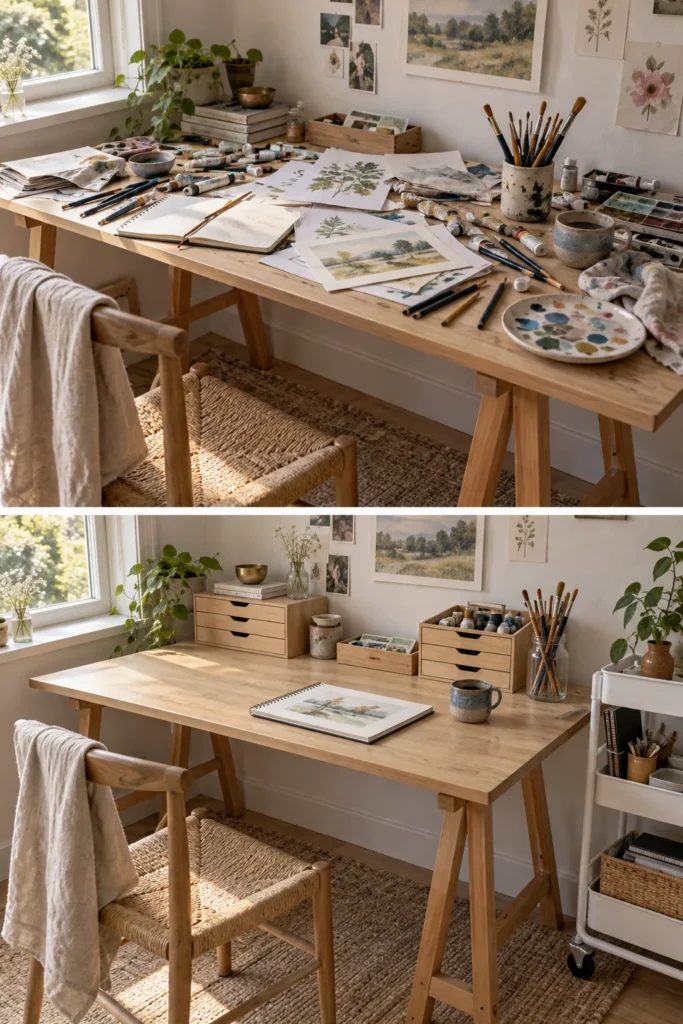
Most art-supply clutter has very little to do with how much storage you own. It comes from undecided supplies: the half-dead markers, the third set of the same pencils, the paint you’re saving for a project you stopped wanting to make. No bin on earth can make those decisions for you.
So here’s my rule, and this whole guide is built on it: buy containers last. Sort first, decide second, zone third. Then you’ll know exactly what to buy, and you’ll buy less of it.
Block out one afternoon, put on a podcast, and work through the six timed steps below.
Quick answer: the 4-hour studio reset at a glance
| Step | Time | What you do |
|---|---|---|
| 1. Sort | 60 min | Pull everything out and group it by category |
| 2. Decide | 45 min | Keep, donate, or toss using three simple tests |
| 3. Zone | 30 min | Give each category a home based on how you work |
| 4. Contain | 60 min | Fit storage to what’s left, then shop |
| 5. Label | 25 min | Label every drawer, bin, and shelf edge |
| 6. Maintain | 20 min | Set up a 3-minute daily reset and a 10-minute weekly one |
If you only do one thing this weekend, do Step 2. Clearing out dried-out and duplicate supplies frees up more room than any new drawer unit will, and it costs nothing.
Gather first: painter’s tape and a marker for temporary labels, four boxes marked Keep, Donate, Toss, and Maybe, scrap paper for testing, trash bags, and a timer. The timer matters. It keeps you moving instead of getting lost flipping through old sketchbooks.
Step 1: Sort everything (60 minutes)
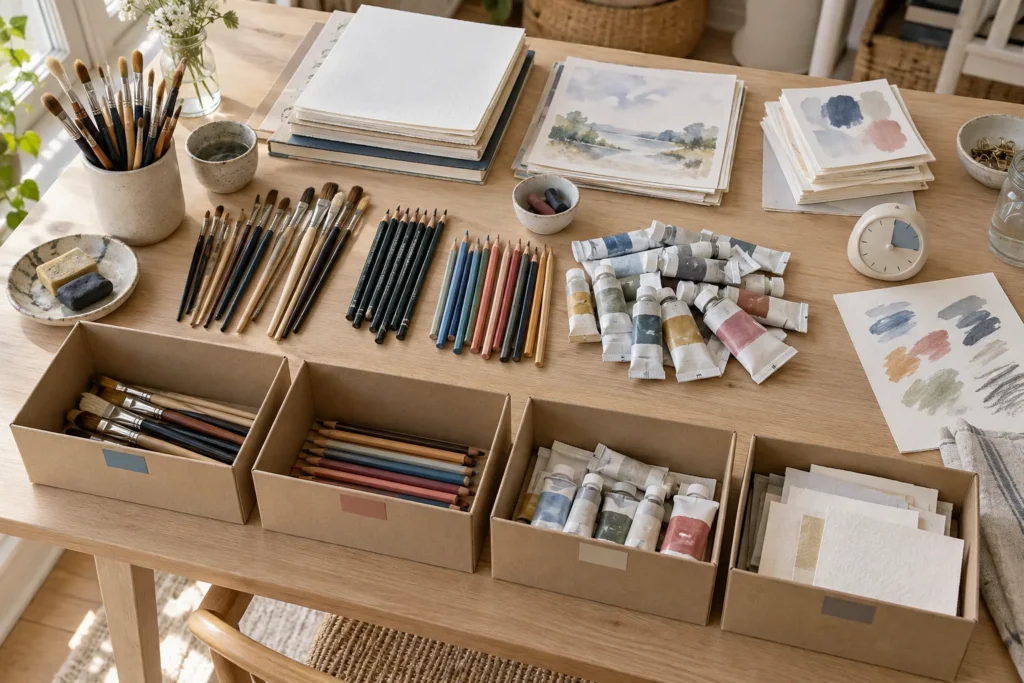
Pull every supply out of every drawer, bin, tote, and closet. The stash in the hall closet counts. So does the bag of markers in the car.
You can’t spot duplicates when they’re spread across four rooms.
Group everything into these piles:
- Brushes and pens
- Pencils, charcoal, and pastels
- Paints by type (acrylic, watercolor, gouache, oil)
- Mediums and solvents
- Paper, sketchbooks, and canvas
- Tools (scissors, craft knives, rulers, palette knives, tape)
- Digital gear (tablets, styluses, chargers, cables)
- Craft and mixed media (glue, washi, collage scraps, embellishments)
Wipe out each drawer as it empties. When the timer hits 60 minutes, stop, even if a few piles are messy. Good enough moves you forward.
Step 2: Decide what stays (45 minutes)
This step does the heavy lifting. Run every pile through three tests.
Test 1: The dried-out test
- Markers and brush pens: scribble a 2-inch zigzag on scrap paper. Streaky or pale? Cap it, store it tip-down overnight, and test again. Still streaky? Toss it, unless it’s a refillable marker you’d actually refill.
- Fineliners and gel pens: draw a 3-inch line. If it skips, it goes.
- Acrylic tubes: squeeze gently. A rock-hard tube is done.
- Acrylic bottles: shake for 30 seconds. If it stays lumpy or smells sour, toss it.
- Gouache tubes: dried gouache rewets like watercolor, so slice the tube open and press the paint into an empty half pan.
- Watercolor pans: these almost never go bad. Keep them unless they’ve crumbled.
- Oil paint: a little oil at the cap is normal, so knead the tube. Toss it only if it’s solid all the way through.
- Glue, tape, and mediums: gelled, skinned over, or lost its stick? It’s finished.
Never pour old solvents or mediums down the drain. Take them to a household hazardous waste drop-off.
Test 2: The duplicates rule
Keep one in use plus one backup. Everything past that gets donated. The only exceptions are things you burn through fast, like titanium white, your favorite 2B pencil, or masking tape. Those can have two backups.
Test 3: The one-year rule
If you haven’t touched it in 12 months, it goes in the Maybe box. Write today’s date on the box, tape it shut, and put it away. If you haven’t opened it in 90 days, donate the whole box without looking inside.
The one exception: supplies for a medium you have a real plan to use, with a date on the calendar. “Someday” doesn’t count.
Schools, libraries, senior centers, scout troops, and creative reuse centers often take art supplies. Call first to ask what they accept.
Step 3: Zone your space (30 minutes)
A zone is the spot where an activity happens, with everything for it within reach. Zoning comes before shopping because it tells you what size and shape your storage needs to be.
Your body pays for bad placement. Every bend to a floor bin and every twist to reach behind you adds up in your back and shoulders. So place supplies by how often you touch them:
- Ring 1, within arm’s reach while seated (about 24 inches): what you use every session, kept between hip and shoulder height.
- Ring 2, one step away: what you use weekly.
- Ring 3, across the room or in a closet: backstock and anything monthly or less.
Heavy things, like paint bottles and reams of paper, belong at waist height, never on the top shelf or the floor.
Sit at your desk and reach out with your elbow bent at about 90 degrees. Whatever you can touch without leaning is your prime real estate. Give it to your five most-used tools and nothing else.
Wet media zone
Paints, water cups, palettes, mediums, and rags live together, ideally near a sink and on a wipeable surface. On a three-tier cart, put daily paints on top, mediums and water cups in the middle, and rags and backups on the bottom.
Heavy Duty Utility Cart with Lockable Wheels, Hanging Cups, Hooks, Mesh Rolling Storage Cart Craft Cart Organizer, Lightweight and Sturdy, White
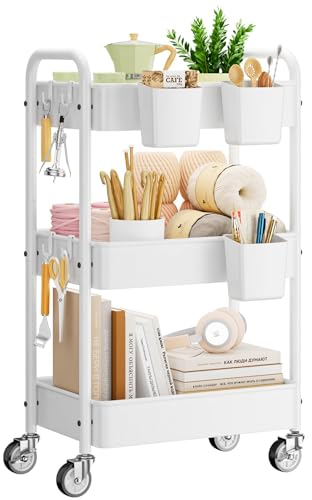
Store paint tubes flat in drawers 2 to 3 inches deep, grouped by color family. Keep solvents capped, labeled, out of direct sun, away from heaters, and out of reach of kids and pets.
4 Sizes Desk Drawer Divider Organizers and Storage Bins for Makeup, Jewelry, Gadgets for Kitchen, Bedroom, Bathroom, Office

Dry media zone
Pencils, charcoal, pastels, and markers do best in shallow drawers where you can see every color at once. Store alcohol markers horizontally so the ink stays even between both tips. Keep soft pastels in their foam slots so they don’t rub each other into dust.
Natural Birch Finish, Foam-Lined Drawers for Brushes, Removable Dividers, Sturdy Wood Construction, Stackable Solution

A stackable caddy holds the 10 to 15 dry tools you grab every day, so the drawer chest can hold the rest.
Korean-Made Portable Tote for Bathroom, Office, Crafts, or School Supplies (Rectangle, White)

Brush and tool zone
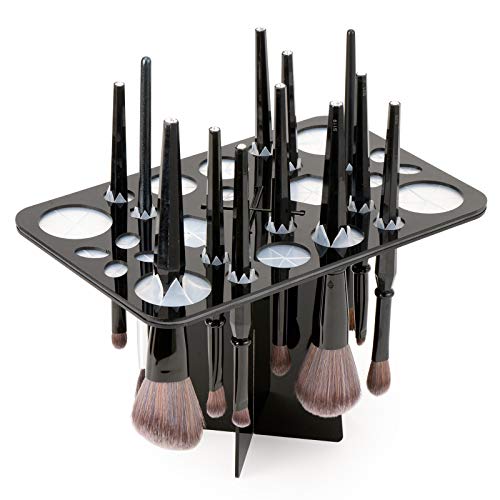
Dry wet brushes flat or tip-down, never tip-up. Water running into the ferrule loosens the glue, and that’s how brushes start shedding. Once dry, stand them upright in jars, one jar per medium.
Collapsible Stand with 28 Slots for Nail, Paint, and Makeup Brushes Black, Unisex, Ideal for Artists and Enthusiasts
A magnetic knife bar at eye level holds palette knives, scissors, metal rulers, and craft knives where you can see them and little hands can’t reach.
Knife Holder, Knife Strip, Magnetic Tool Organizer, Art Supply Organizer & Home Organizer

Paper and canvas zone
Keep paper away from windows, radiators, and exterior walls, at about 40 to 50 percent humidity so it doesn’t buckle. Store loose paper flat, sketchbooks upright like books, and canvases upright in a rack, never leaning on their corners.
Art Canvas Storage, 9 Section Wooden Painting Drying Rack Display Stand for Frames, Drawing Board, Canvas, Printed Matters Suitable for Studio


The details are in how to store canvas, paper, and sketchbooks.
Digital and mixed media
Give your tablet and chargers one spot with a power strip, at least an arm’s length from any water cup. Tag both ends of every cable. For craft and mixed media, use clear lidded bins sorted by type, and cap the count at one shelf. When the shelf is full, the category is full.
Step 4: Contain (60 minutes)
Now you shop. Measure first: drawer interiors, wall space above your desk, and the gap under it. Then match the container to the item:
- Tubes, pencils, pens: shallow drawers, 2 to 3 inches deep
- Bottles and jars: upright on tiered shelves or a cart, labels facing out
- Paper: flat drawers at least one size larger than your biggest sheet
- Daily tools: open cups or a pegboard in Ring 1
- Backstock: lidded, opaque bins in Ring 3
- Soft or bulky items (rags, fabric): baskets
Quick picks: storage by job
| Job | My pick | Price tier |
|---|---|---|
| Daily wet-media cart | YASONIC Metal 3-Tier Rolling Cart | $ (around $35) |
| Small items inside drawers | WOWBOX 25-piece clear drawer organizers | $ (around $17) |
| Pencils, pastels, charcoal | HG Art Concepts 4-Drawer Artist’s Chest | $$ (around $75) |
| Paper and sketchbooks | DEVAISE 7-Drawer Chest | $$ (around $100) |
| Canvases | Julymoda Art Storage Rack | $$ (around $80) |
| Wall storage | Wall Control steel pegboard | $$ (around $40 to $60) |
| Labels | NIIMBOT B1 Label Maker | $ (around $40) |
| Hide the whole studio | Sauder Craft & Sewing Armoire | $$$ (around $420) |
Pegboard: the cheapest wall you’ll ever love
A pegboard moves daily tools into Ring 1 without using floor space. I recommend steel over hardboard, because hardboard hooks loosen and fall out every time you grab something. The Wall Control steel pegboard holds hooks firmly and takes magnets too.
It’s worth the money if you work at the same desk every day and have bare wall above it. Skip it if you rent somewhere strict about holes. Hang it with the bottom edge about 6 inches above your desk.
Carts, baskets, and shelves
A cart is a zone on wheels: park it beside you, then roll it into a closet when the room needs to be a guest room again. Baskets hide visual noise, so they belong in Ring 3 for spare sketchbooks, rags, and fabric.
Decorative Woven Baskets with Built-in Handles, Hand-woven Storage Organizer for Organizing Pantry, Livingroom, Bedroom, Shelves, Toilet(2-PACK, Blended)

For more options, see the best rolling art carts and the best shelves for art studios.
Step 5: Label everything (25 minutes)
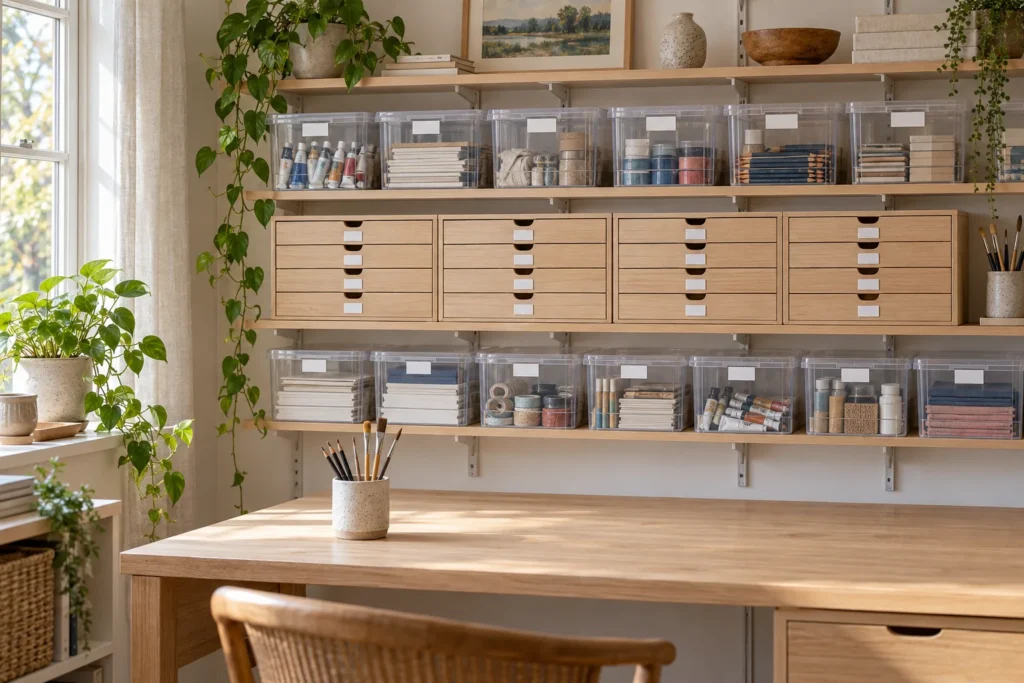
Labels keep the system working when you’re tired, rushed, or when someone else is putting things away.
- Label the front edge, not the lid. Lids get swapped.
- Use category plus detail, like “Acrylics: Warm” or “Charcoal: Vine.”
- Three words or fewer, in the same font and size everywhere.
- Label clear bins too. Seeing what’s inside doesn’t tell you what belongs inside.
Add colored dot stickers to paint drawers by family: warm, cool, earth, and metallic. You’ll find colors faster and notice when a family runs low.
Thermal Label Printer Easy to Use for Office, Home, Business, Came with 3 Roll White Labels(Blue)

If you prefer a keyboard-style labeler, the DYMO label maker is a reliable pick.
Step 6: Set up maintenance (20 minutes)
Use these last 20 minutes to make upkeep automatic.
- Daily, 3 minutes: caps on, brushes washed and laid flat, Ring 1 tools back, desk wiped.
- Weekly, 10 minutes: return strays, empty water cups and trash, restock Ring 1 from backstock.
- Every 3 months, 30 minutes: re-test markers, check the date on your Maybe box, and look at what’s overflowing.
- Always: one in, one out. A new pencil set means an old one leaves.
Write the daily and weekly lists on an index card, tape it inside a cabinet door, and set two repeating phone reminders.
Investment pieces worth it (only after Step 2)
These are buy-once pieces. Buying big storage before a purge just gives clutter a nicer home.
Buy for the supplies you kept, sized for the space you measured.
Sauder Craft & Sewing Armoire
The Sauder Craft & Sewing Armoire in Glacier White runs around $420, and the Mystic Oak version around $525. It puts a whole studio of shelves and drawers behind doors you can close.
Worth it if your studio shares a living room, guest room, or bedroom. Over five years, $420 is about $1.60 a week for a room that looks finished.
Skip it if you have a dedicated studio with open walls. A pegboard plus a drawer chest covers the same ground for a third of the price.
72-inch craft storage cabinet with LED lights
This 72-inch craft storage cabinet costs around $280. It’s tall and narrow, so it holds a lot on a small footprint, and the lights make labels on the back of a shelf easy to read.
Worth it if you like supplies on display and you’re short on floor space. Skip it if you’d rather hide everything. Either way, anchor any 6-foot cabinet to the wall.
Bisley steel multi-drawer cabinets
Bisley steel drawers are a design-studio classic. The 6-drawer in Oxford Blue is around $245, the 8-drawer in Doulton Blue around $275, and the 3-drawer in black around $138. The drawers are sized around A4 paper (about 8.3 by 11.7 inches) and run shallow, which suits tubes, pencils, pens, and small pads.
Worth it if you want storage that won’t sag or crack and wipes clean after a spill. Skip it if you mostly work on 11-by-14-inch paper or larger.
AdirOffice 5-drawer flat file
The AdirOffice 5-Drawer Flat File holds documents up to 29 by 40 inches for around $735, well under the price of most professional flat files.
Worth it if you work on full sheets of watercolor paper (22 by 30 inches), sell prints, or keep finished work on paper. One full sheet of professional watercolor paper often costs $10 or more, so a few ruined sheets a year add up. Skip it if your work lives in sketchbooks and 9-by-12-inch pads. The DEVAISE chest handles that for around $100.
More options at every price: best drawer units for artists.
If you only have a corner
The six steps work the same; you just end up with fewer zones. My small-space formula is one rolling cart for wet media, one shallow drawer chest for dry media and paper, and a pegboard above the desk. That covers all three rings in about 4 square feet of floor. More in small art studio organization ideas.
The takeaway
Organized studios come from decisions, and containers come last. Sort everything, run the dried-out, duplicates, and one-year tests, zone by how often you reach for things, and only then buy storage to fit what’s left. Protect it all with a 3-minute daily reset.
Which step is your studio stuck on right now: sorting, deciding, or keeping it that way? Tell me in the comments, and save this to your studio board for your next rainy weekend.
[…] The Ultimate Guide to Organizing Your Art Supplies […]