This post contains affiliate links. If you buy through them, I may earn a small commission at no extra cost to you.
If your favorite round brush has a frizzy tip and half your markers write pale on one end, look at how they spend the hours between sessions before you blame the brand.
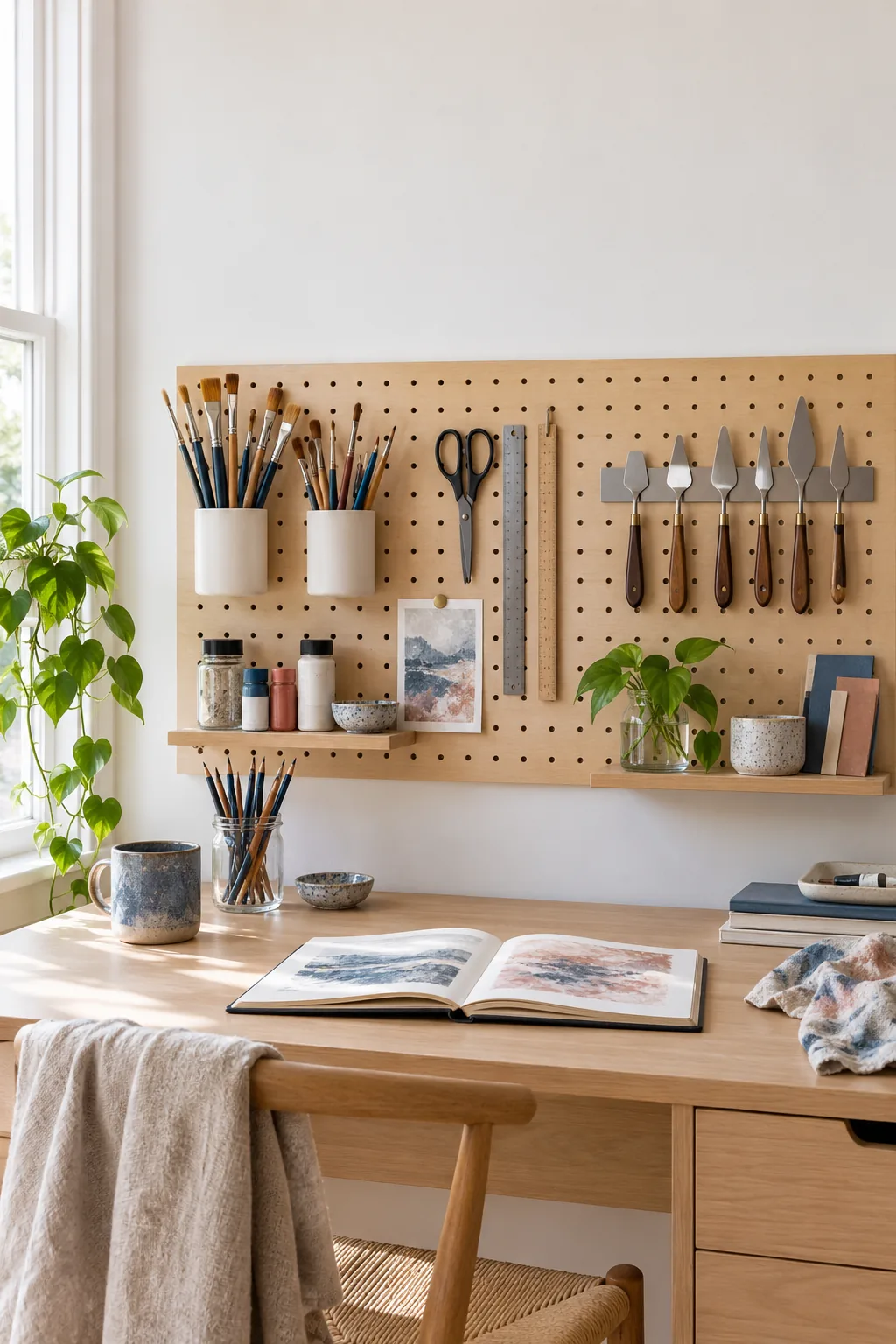
My point of view is simple: organizing brushes, pens and tools is mostly a care job. The right storage decides how long a $20 brush keeps its point and whether a $6 marker lasts a year or a month. Pretty jars come second.
And there’s one more rule I care about, because your shoulders will thank you: the tools you grab every day belong within your forearm’s reach.
Quick answer: if you only do one thing
Pick your “daily five,” the five tools you reach for every session, and put them within about 15-18 inches of where your hand rests, roughly the length of your forearm plus hand. If you can grab them without leaning, twisting or lifting your elbow off the table, they’re in the right place.
Step 1: Sort before you store
Dump everything onto a towel and group it.
- Brushes: rounds, flats, detail, mop, fan; then split synthetic from natural hair.
- Pens and markers: fineliners, brush pens, alcohol markers, gel pens.
- Drawing tools: pencils, erasers, blending stumps, sharpeners.
- Cutting tools: craft knives, blades, scissors.
- Measuring tools: rulers, triangles, compasses.
- Craft tools: bone folders, tweezers, glue pens.
Test every pen on scrap paper. Faint or scratchy ones go in a “revive or recycle” pile.
How to store brushes so they keep their shape
Brushes have three parts: the hairs, the metal ferrule that holds them, and the handle. Almost every ruined brush failed at the ferrule.
The rules
- Never leave brushes standing bristles-down in water. Even 20 minutes bends the tip, and over time the wooden handle swells and the lacquer cracks.
- Dry brushes flat or tip-down. Standing a wet brush upright lets water run down into the ferrule, where it softens the glue and loosens the hairs. That’s when brushes start shedding.
- Reshape the tip while damp. Gently pinch rounds back to a point and flats back to a sharp edge before they dry.
- Store upright only once fully dry. Then upright in a jar is perfect, hairs up and not touching anything.
- Give natural hair airflow. Sable, squirrel and hog hair are animal fibers. Sealed in a damp box, they can mildew, and natural hair can attract moths. Store them in an open jar or a breathable roll.
- Separate by medium. Oil and acrylic brushes get their own jar, watercolor brushes get theirs. Residue travels.
Drying racks
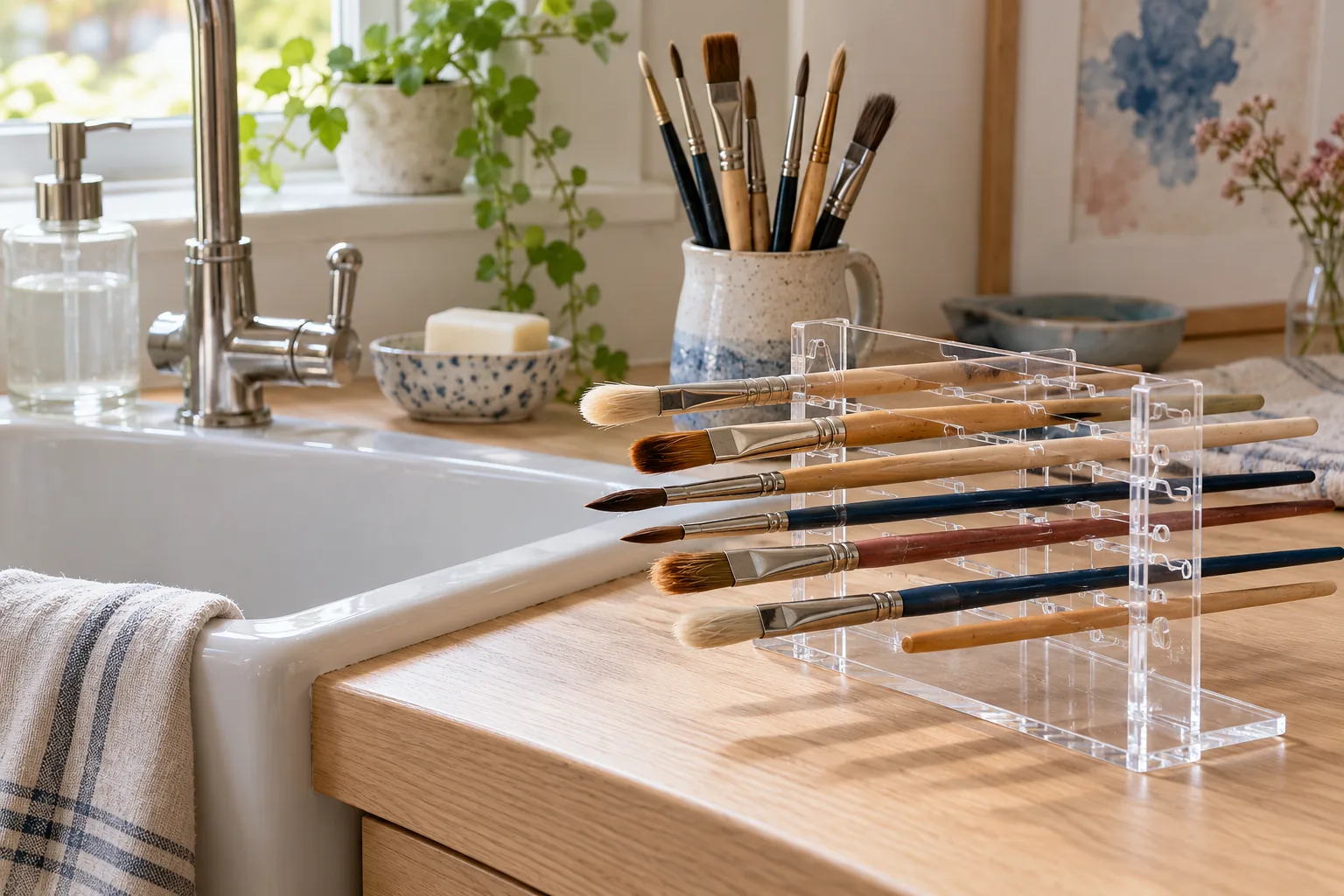
A drying rack holds brushes horizontally or tip-down so water drains away from the ferrule. This is the single most useful brush accessory for anyone who paints wet.
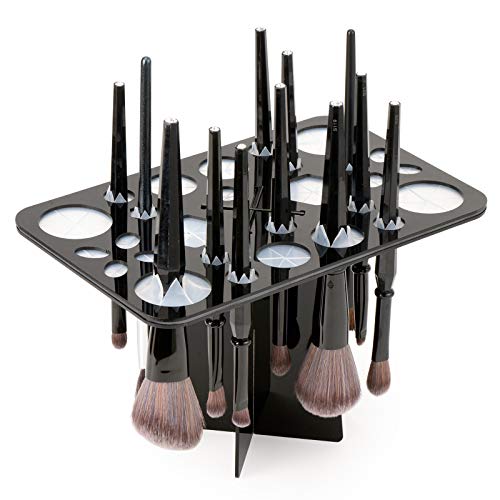
Collapsible Stand with 28 Slots for Nail, Paint, and Makeup Brushes Black, Unisex, Ideal for Artists and Enthusiasts
Jars and rotating holders for dry brushes
Once brushes are dry, open jars are the easiest everyday storage. One jar per medium, tallest brushes at the back. A rotating holder keeps the full set in a single footprint on a small desk.
Make Up Brush Organizer Removable Spinning Cosmetic Brushes Storage Pen Holder for Vanity, Dresser, Desk, Beige

6 Support Bead Options. Thick, Durable, Crystal-Clear Acrylic with Diamond-Polish Finish. Paint Bottle Organizer & Painting Storage. SB

Brush rolls and drawers
For travel or brushes you use less often, a canvas or bamboo roll protects tips and still breathes. In drawers, use dividers so brushes don’t roll together.
How to store pens and markers so they don’t dry out
Ink moves with gravity. Store markers the wrong way and the ink settles where you don’t want it.
The rules
- Store dual-tip alcohol markers horizontally. Lying flat keeps ink spread evenly to both nibs, so neither end goes pale.
- Store most single-tip markers and fineliners horizontally too. It’s the safe default when the packaging doesn’t say otherwise.
- Click caps all the way on. A cap that’s only partly seated is the most common reason a marker dies early.
- Keep markers out of sun and heat. A sunny windowsill can dry alcohol markers in weeks.
- Pencils, gel pens and ballpoints can stand in cups. They don’t care about orientation the way markers do.
Where to put them
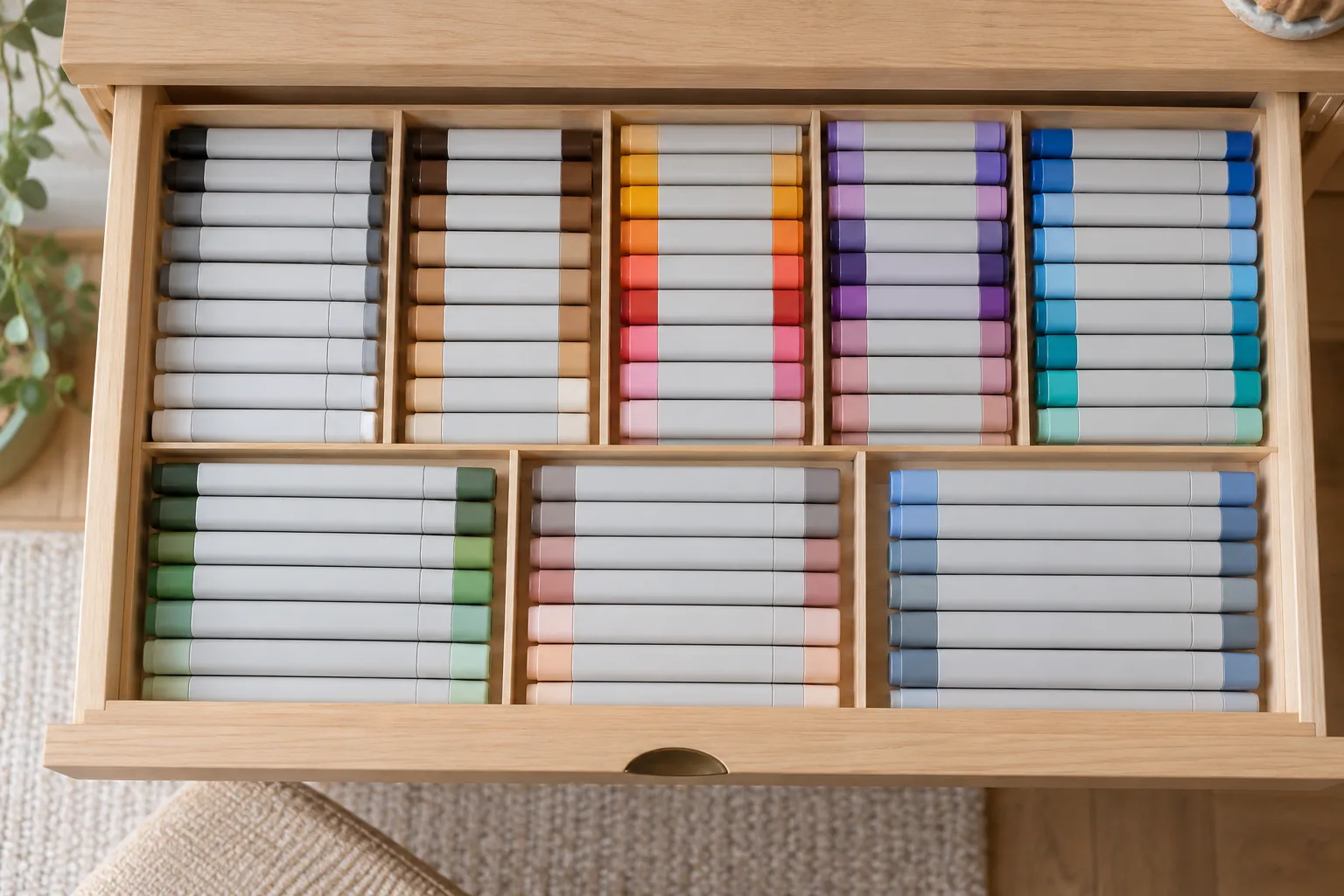
Shallow drawers and lay-flat trays work best for marker sets because they keep everything horizontal and sorted by color family. Cups and rotating organizers work for pencils, gel pens and the few pens you use daily.
Dual-Purpose Art Supply Pencil Cup for Office, School, Home

Korean-Made Portable Tote for Bathroom, Office, Crafts, or School Supplies (Rectangle, White)


Sort markers by color family (warm, cool, neutral, skin tones) rather than by number. Most people think in colors, not codes, and you’ll find what you need faster.
How to store tools (and blades safely)
- Magnetic strips hold scissors, metal rulers, palette knives and tweezers where you can see them. Mount one just above the back edge of your desk.
- Pegboards let you hang rulers, triangles and tape, with cups for small pieces.
- Divided drawers keep erasers, sharpeners and blending stumps from mixing.
- Blades go in a closed container. Always. Store spare craft knife blades in their original case or a small lidded tin, and cap your knife every time you set it down. Keep a separate labeled tin for used blades, and tape it shut before it goes in the trash.
Knife Holder, Knife Strip, Magnetic Tool Organizer, Art Supply Organizer & Home Organizer


Peg Board Hooks Assortment Organizer Accessory, Various Tools Storage Arrange System Kit for Garage Craft Workshop Workbench Hobby

Set up your reach zones
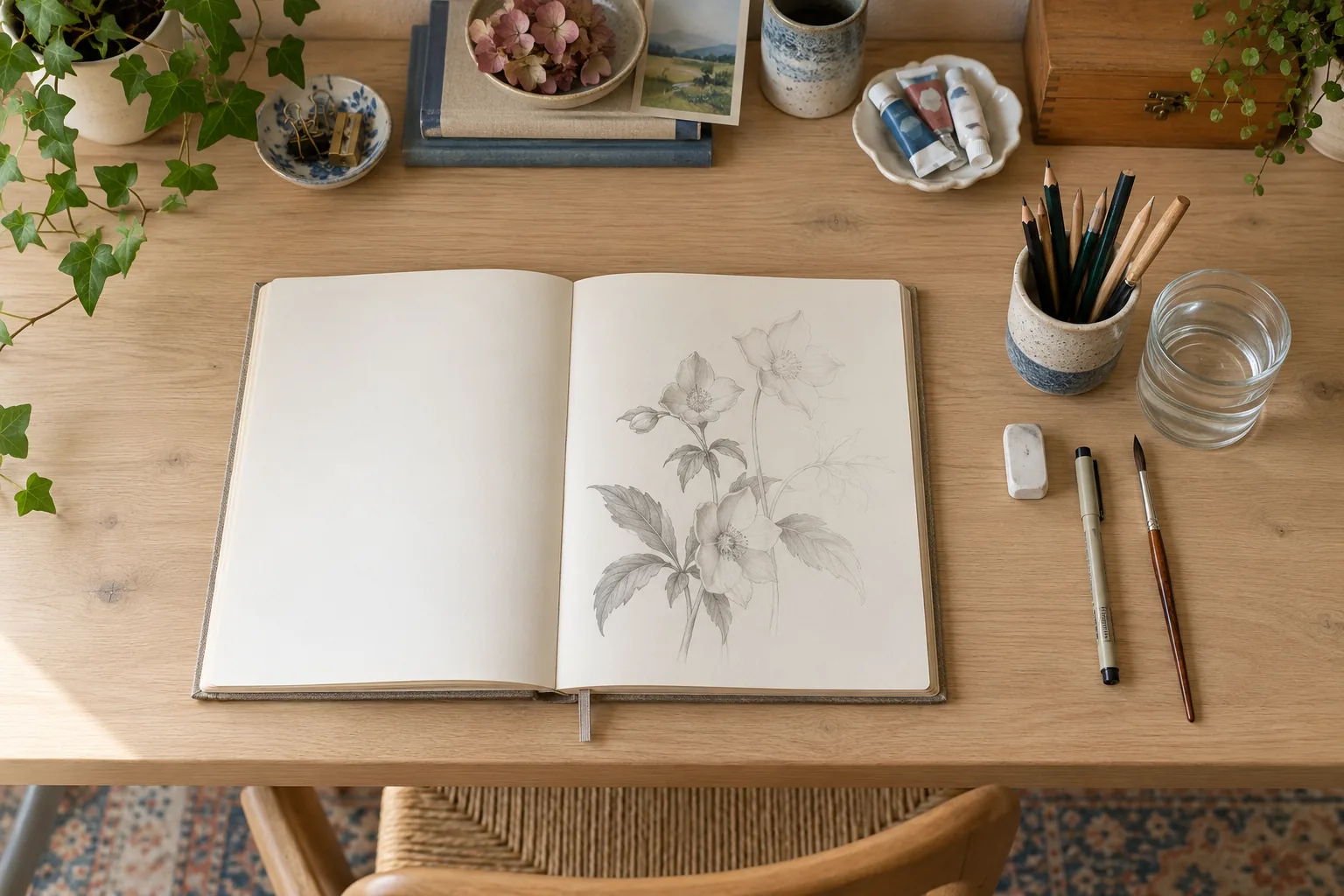
This is where organization meets your body. Every twist to grab a pen from behind you rotates your spine and lifts your shoulder. Do that 50 times a session and your neck feels it by evening.
Think of your desk in three zones:
- Zone 1, within forearm’s reach (about 15-18 inches): your daily five. Usually a drawing pencil, an eraser, one fineliner, your favorite brush and a water cup or palette. Your elbow stays down and close to your side.
- Zone 2, full arm’s reach (about 24-28 inches): tools you use most sessions but not constantly. Marker tray, brush jar, ruler.
- Zone 3, stand up and get it: backup supplies, specialty tools and anything you use less than weekly.
Put your daily five on the side of your dominant hand. If you’re right-handed, the cup sits to your right, slightly forward, so you’re reaching out and not back.
If you notice yourself leaning or twisting for the same item three times in one session, move it into Zone 1. Your neck will thank you.
Want the full desk setup? See how to set up an art studio for desk height, chair and lighting.
Make it beautiful (so you keep it up)
People maintain systems they enjoy looking at. A few easy wins:
- Match your containers. Three ceramic jars in one color read as calm; six mismatched mugs read as clutter.
- Use one material family. Light wood, white ceramic and clear acrylic all play well together.
- Leave 20% empty space in every drawer and cup so things go back easily.
Investment pieces worth it
Here’s where spending more pays off over years of use.
Bisley steel multi-drawer cabinet
The classic design-studio drawer unit: steel, smooth-gliding, shallow drawers that hold pens, markers and tools flat and sorted.
- Bisley 6-Drawer Steel MultiDrawer Cabinet, about $245.
- Bisley 3-Drawer Steel Cabinet, Black, about $138.
Worth it for: marker collectors and anyone with lots of small tools who wants shallow, lay-flat drawers that last decades. Six drawers at $245 used weekly for 5 years comes to under $1 a week. Skip it if: your collection fits in one drawer today. A bamboo divider set in a desk drawer gets you 80% of the way for about $35.
Wall Control steel pegboard
Steel pegboard holds heavier tools than hardboard and doesn’t sag or tear out around the holes.
- Wall Control metal pegboard, about $40-60.
Worth it for: anyone with a wall beside the desk and tools that keep getting buried. It’s the easiest way to move Zone 2 up off the desk. Skip it if: you rent and can’t drill, or your wall space is already holding shelves.
MEEDEN solid beech rolling cart
A taboret-style cart that rolls up beside you while you paint, then tucks away. It’s the best way to bring Zone 1 with you when you move from desk to easel.
- MEEDEN Rolling Art Supply Cart, solid beech, about $158.
Worth it for: painters who work at an easel and at a desk, and anyone who wants their daily five mobile. Skip it if: you only work in one spot. A desktop caddy does the job.
A premium colored pencil set (if pencils are your medium)
If colored pencil is your main medium, good pencils are the tool you touch most, and a tin keeps them sorted and protected from the start.
- Faber-Castell Polychromos 120 tin, about $295. Oil-based, firm cores that sharpen to a fine point.
- Caran d’Ache Luminance 40, about $172. Soft, highly lightfast wax-based pencils, a smaller set at a higher price per pencil.
Worth it for: artists who use colored pencil several times a week and want lightfast color. Skip it if: you’re still exploring mediums. Start with a 24-set and buy open stock of the colors you use up.
Weekly, monthly and seasonal care
- After each session (2 minutes): wash and reshape brushes, lay them on the drying rack, cap every marker.
- Weekly (10 minutes): return strays to their zone, test any marker that felt dry, wipe the brush jars.
- Monthly: wash brush holders, check ferrules for loose hairs, sharpen pencils in bulk.
- Seasonally: re-sort your daily five. What you reach for in winter oils might change by summer sketching.
The takeaway
Store brushes flat or tip-down until dry and never bristles-down in water, keep dual-tip markers horizontal, and put blades in a closed container. Then pull your daily five into forearm’s reach so your neck and shoulders stay out of the picture.
What’s in your daily five? Share them in the comments. I love seeing what other artists can’t live without.
Save this pin for your next studio reset.
[…] → How to Organize Your Brushes, Pens & Tools → How to Store Canvas, Paper & Sketchbooks […]