This post contains affiliate links. If you buy through them, I may earn a small commission at no extra cost to you.
You cleared off the desk, bought the cute bins, and two weeks later the corner looks exactly like it did before. That’s a very fixable problem.
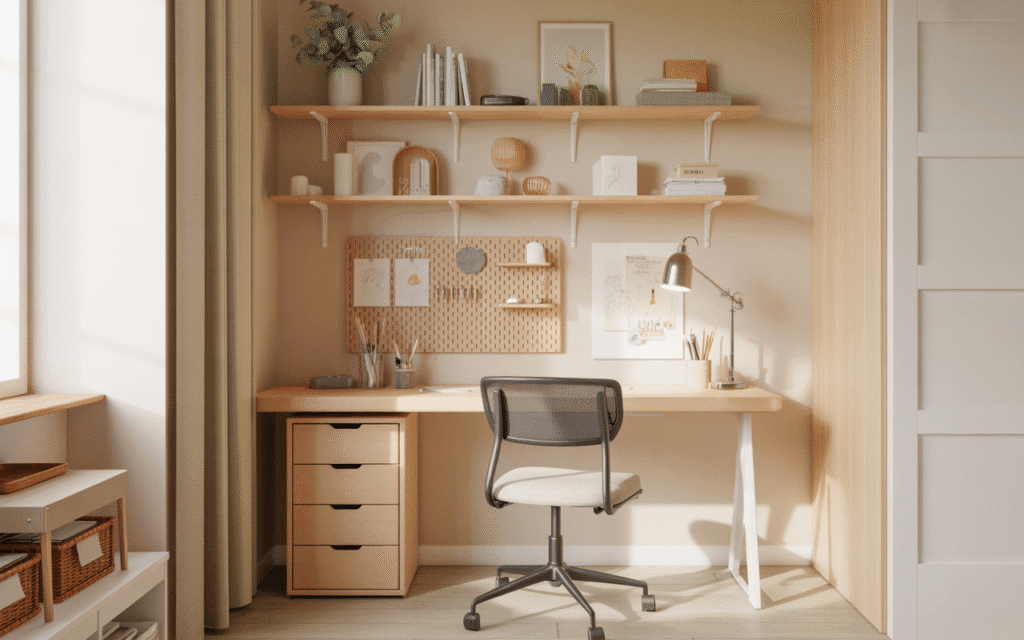
Here’s what I believe: small studios run out of systems long before they run out of room. The square footage is rarely the issue. The issue is that every supply is competing for the same 30 inches of desk because nothing else has a job.
Give every surface a job, use the wall, and pick furniture that does two things. A 4-foot corner can hold more art supplies than most people own.
If you only do one thing: buy a 3-tier rolling cart and move every supply you use daily onto it. Your desk clears instantly, and the cart rolls away when the room needs to be a room again.
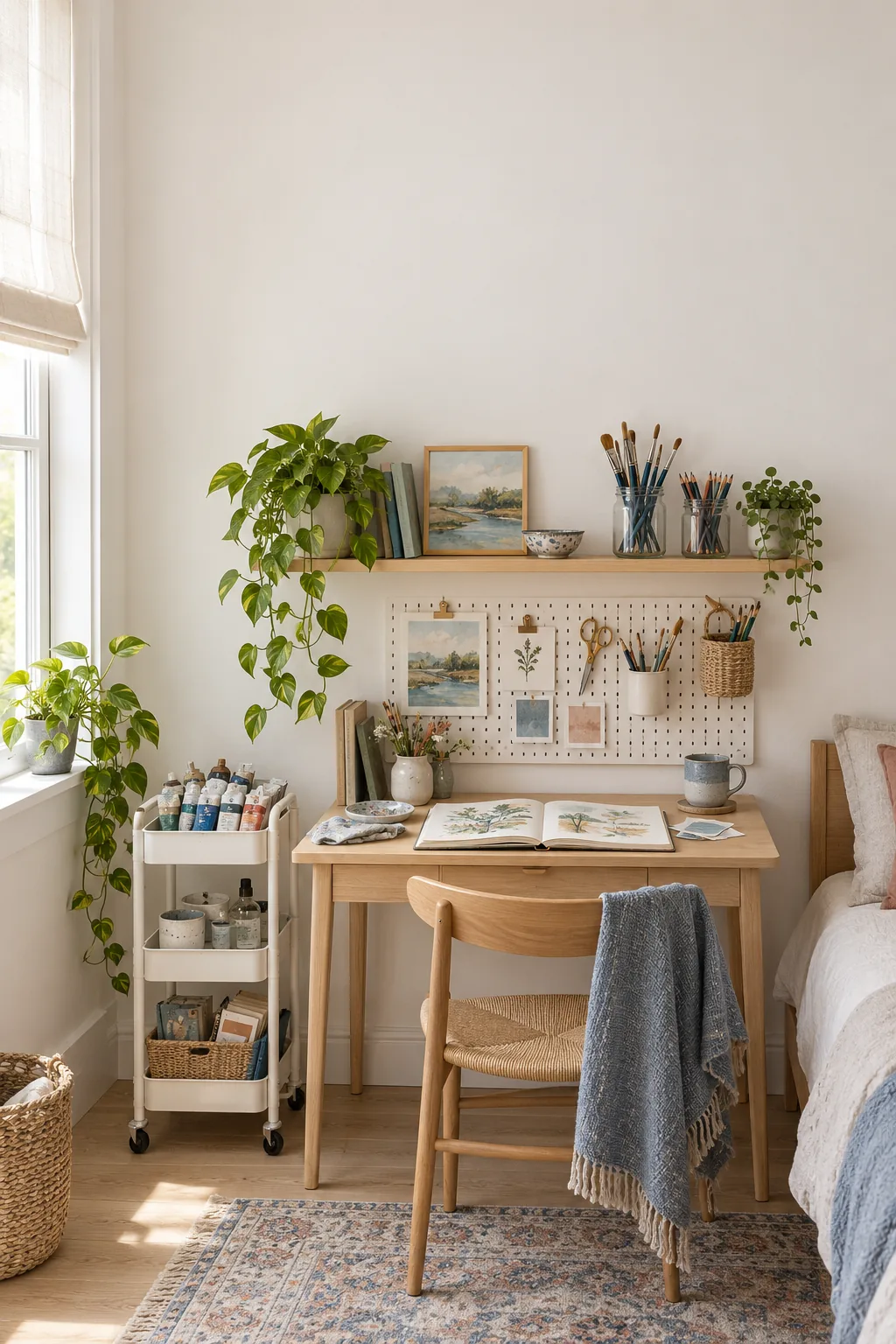
1. Define your zone before you buy anything
A small studio needs a border, even an invisible one. Pick the exact footprint: a corner, a closet, one wall, or half a table. Measure it. Write down the width, depth, and ceiling height.
Then put the studio in the best light that spot offers. A window to the side of your desk (left side if you’re right-handed) gives you light without glare on your paper.
A compact desk that fits the footprint becomes the anchor. Look for one 40-48 inches wide and 20-24 inches deep, with a shelf or drawer so it stores as well as holds.
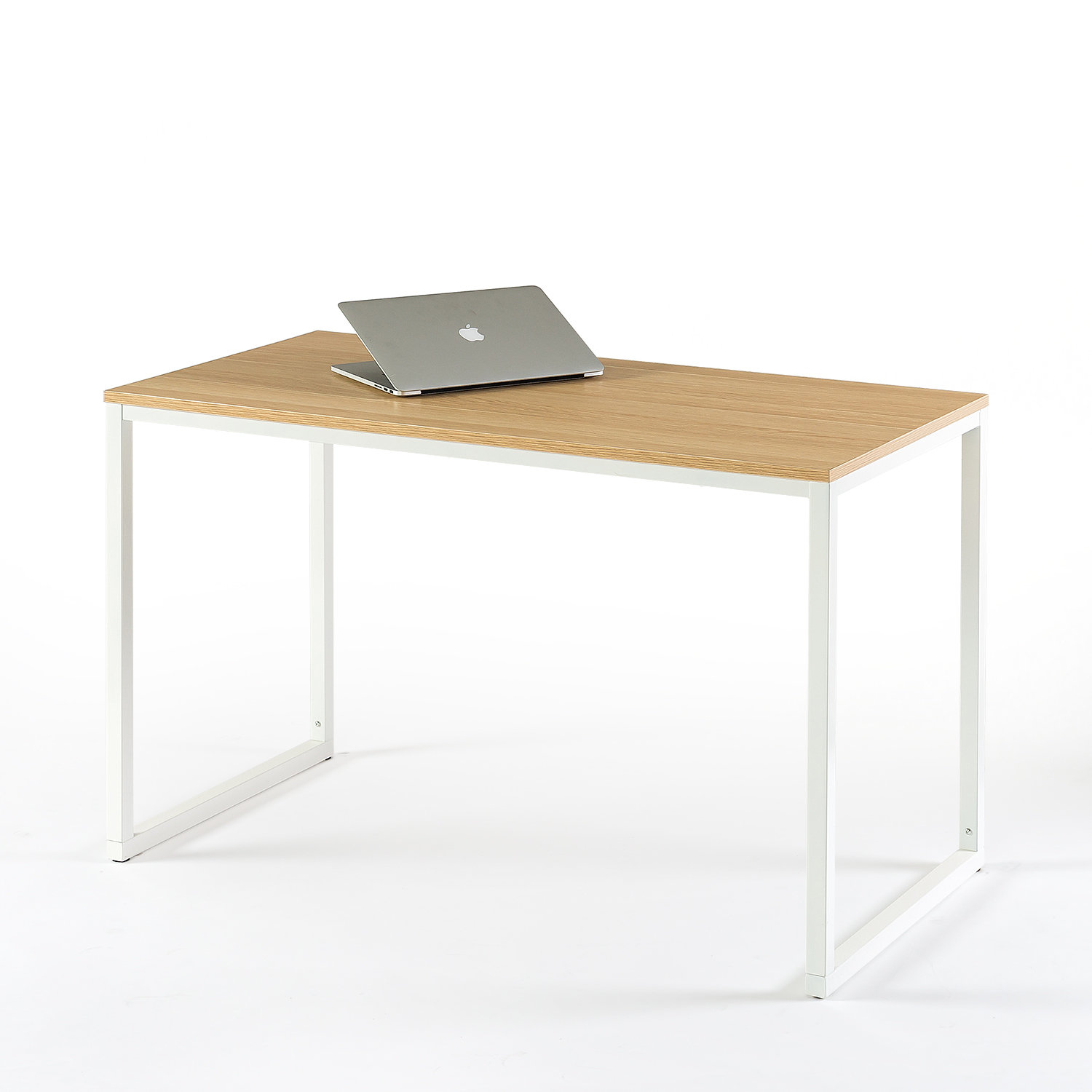
Check your desk height before you fill it. Sitting with relaxed shoulders, your elbows should bend at about 90 degrees with your forearms resting on the surface. Small-space desks are often an inch or two off, and a seat cushion or adjustable chair fixes it for free.
2. Go vertical: the wall is your biggest drawer
In a small studio, the wall above your desk is the most valuable storage you have.
Pegboard for tools
A pegboard above your desk holds scissors, rulers, tape, and cups of pencils and brushes where you can see them. A 2×2 or 2×3 foot panel is plenty for a corner studio.

Floating shelves for jars and sketchbooks
One or two shelves, 8-10 inches deep, hold paint jars, brush cups, and a row of sketchbooks stored upright like books. Hang the first shelf about 18 inches above the desk so you can lean in to work without hitting it.
60inch Floating Shelf for Wall Mounted, Honey Oak Wooden 60in Large Floating Shelves, Heavy Duty Bracket, 60 X 6.5 X 1.75 in, Set of 2

If you want a shorter shelf, the Loon Peak Ilkan solid wood floating shelf is a warm, simple option.
Magnetic strips for metal tools
A magnetic strip holds palette knives, metal tubes, scissors, and metal-clipped references flat against the wall. It takes up zero desk space.
Long Wide 12" x 3" Metal Organizer with Strong Magnets & Wall-Mounting Hardware for Home, Office, or Dorm (3 Pack) Matte Black

Keep your daily tools between hip and shoulder height. That’s the zone you can reach without bending or stretching, and reaching for the floor or over your head dozens of times a session wears on your back and shoulders more than you’d guess.
3. Choose furniture that does two jobs
Every piece in a small studio should store something, fold, roll, or all three.
Slim drawer units
A narrow drawer chest fits beside or under a desk and swallows paints, pencils, and paper. Shallow drawers (2-3 inches deep) beat deep ones: you see everything at a glance and nothing gets buried.

For a smaller, prettier version that sits right on the desk, the 7 Elements 6-drawer beechwood art supply storage box keeps pencils and pens sorted and looks lovely doing it.
Rolling carts
A cart under or beside the desk is the hardest-working item in a small studio. Load it by frequency: daily tools on top, paints and mediums in the middle, paper towels and backstock on the bottom.
Mobile Utility Cart Kitchen/Under Desk Cart with Caster Wheels - WHT (15.35" X 10.24" X 26.8"H)

If you need more sorting than three open tiers, the KINGRACK 12-drawer rolling cart with wooden top gives every supply category its own drawer and doubles as a side table.
Fold-down and folding desks
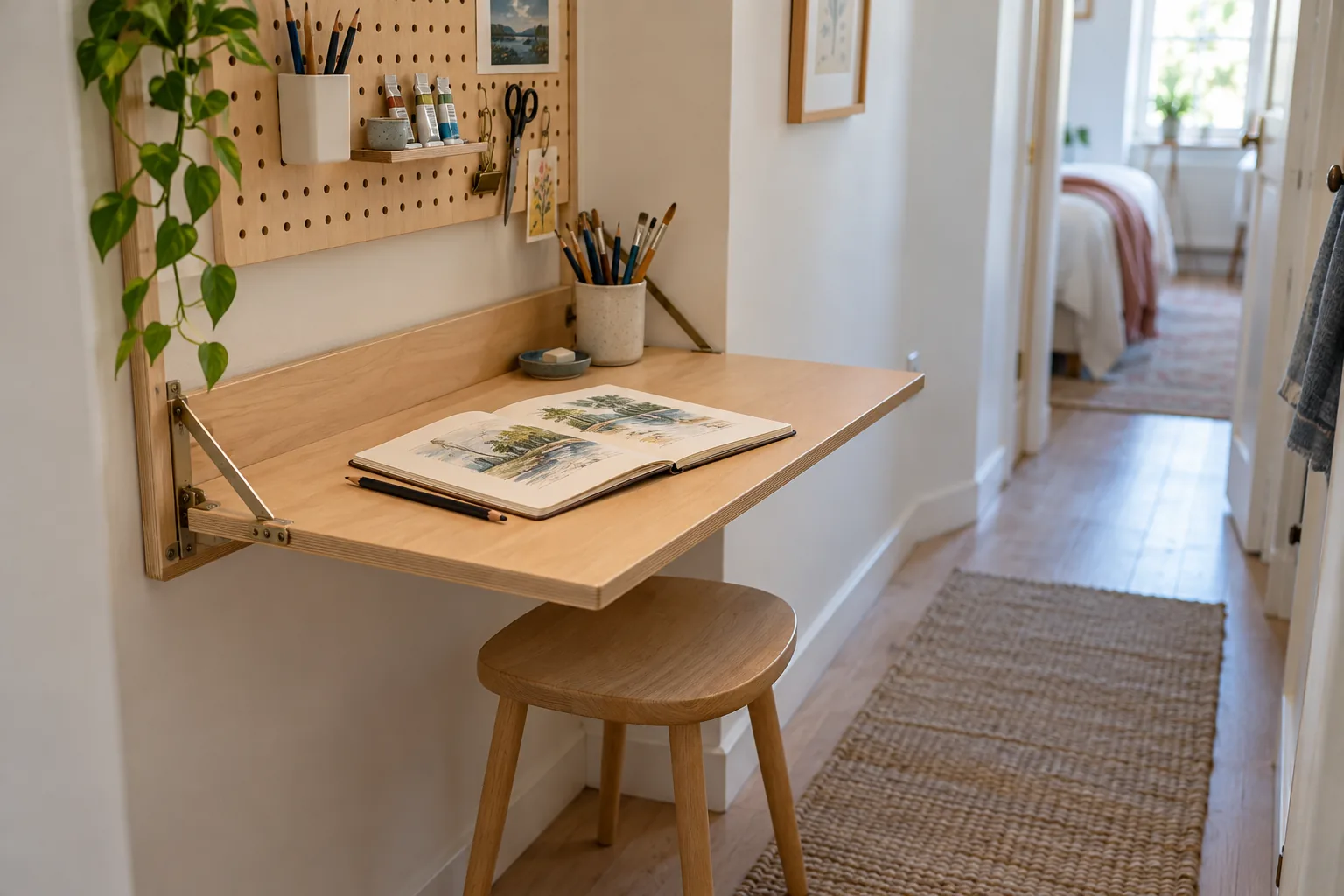
If your studio shares a room, a desk that folds away gives you the floor back. A wall-mounted fold-down table opens into a work surface and closes flat against the wall, often less than 6 inches deep when closed.

Baskets for the soft stuff
Rags, drop cloths, sketchpads, and yarn or fabric for mixed media go in a lidded or open basket under the desk. Baskets hide visual clutter better than clear bins.
4. Create micro-zones on one desk
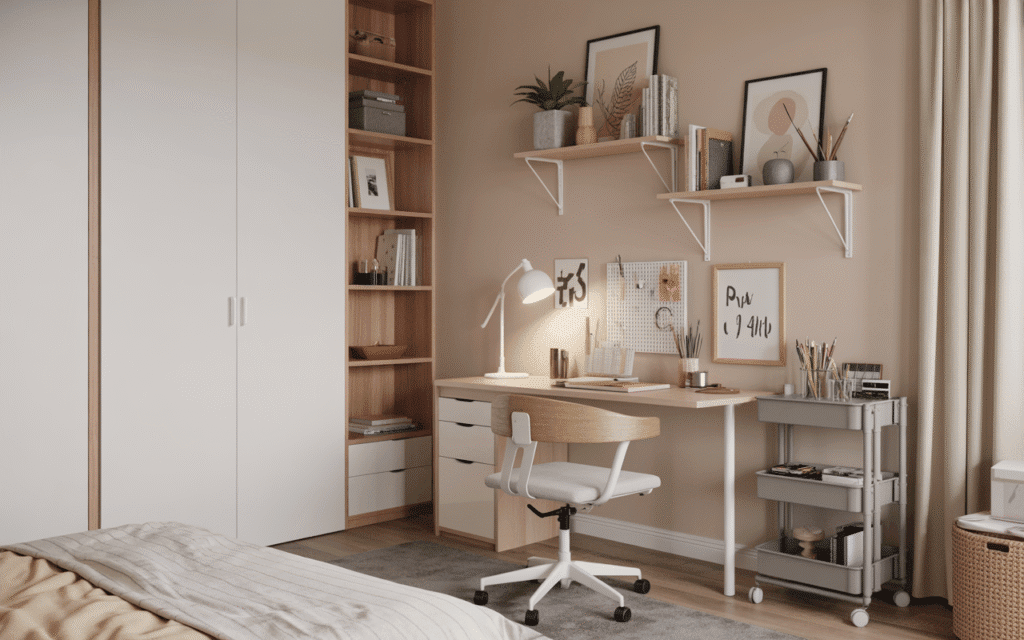
You don’t need separate rooms for separate mediums. You need separate spots. Divide your desk and cart into small zones so nothing wanders.
- Wet zone: paints, water cups, and brushes on one side, ideally your dominant side, with a caddy you can lift away to wipe the desk.
- Dry zone: pencils, charcoal, erasers, and pens in shallow drawer organizers on the other side.
- Paper zone: a vertical file holder for pads, loose sheets, and in-progress pieces. Keep it at least an arm’s length from water.
- Tool zone: scissors, tape, rulers, and craft knives on the pegboard or magnetic strip.
Korean-Made Portable Tote for Bathroom, Office, Crafts, or School Supplies (Rectangle, White)

Clear PET Desk Organizer and Storage Bins Holding for Magazines, Binders, Notebooks, Envelopes, Multi-purpose Plastic Document Organizer for Home Office, 4 pack

For a deeper system for each medium, see the ultimate guide to organizing your art supplies.
5. Use hidden storage for the backstock
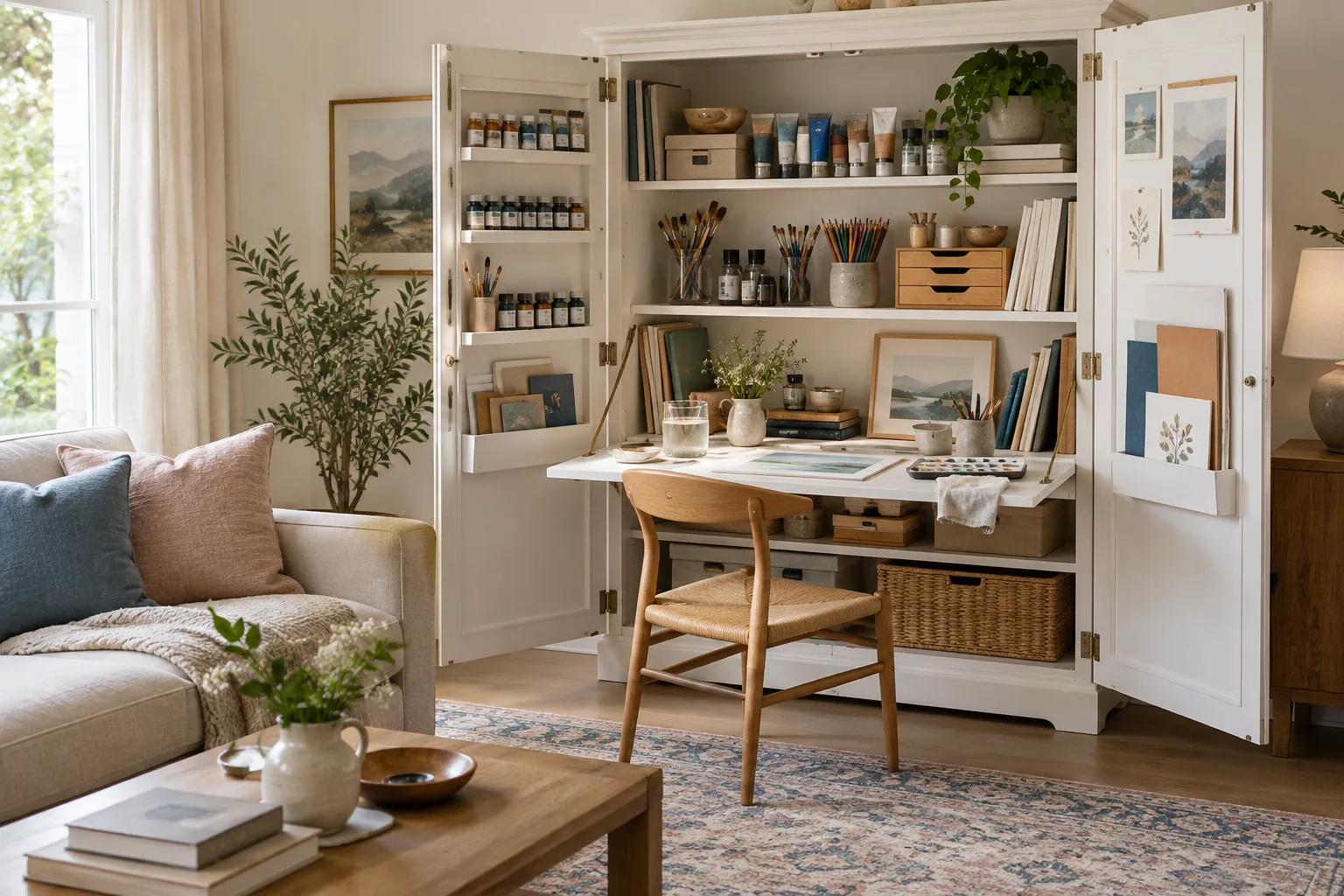
Your small studio should only show what you use this month. Everything else (extra canvases, refill paints, seasonal projects) goes behind a door.
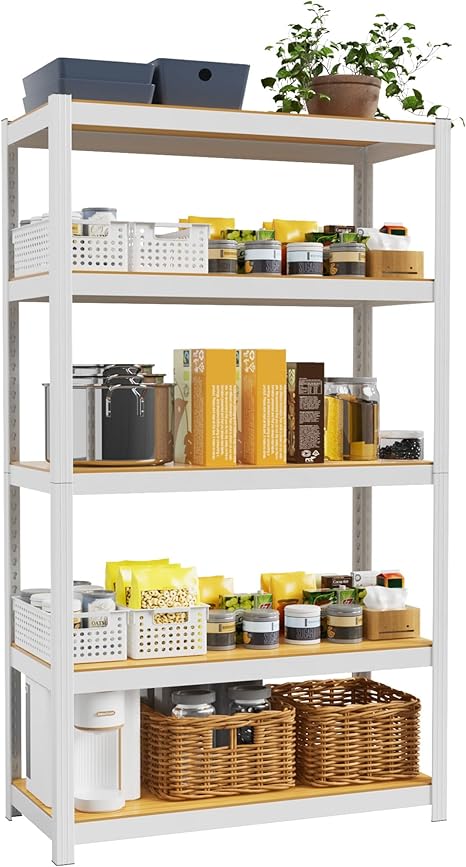
- A closet shelving unit turns a coat closet into a supply closet. Label each shelf by category.
- Under the bed holds flat paper in shallow, lidded boxes. Keep it there only if the room stays around 40-50% humidity and off an exterior wall.
- A storage ottoman doubles as a seat for a guest and a hiding spot for sketchbooks.
5 Tier White Metal Shelving Unit,Adjustable Heavy Duty Garage Shelves,Utility Rack Organizer Shelf for Kitchen Pantry Closet Garage
6. Keep the desk clear
A small desk only works when it starts empty. My rule: the only things that live on the desk are a lamp, one container of daily tools, and whatever you’re working on right now.
Everything else has a home on the wall, the cart, or behind a door. When you finish a session, the desk goes back to bare. It feels strict for a week, then like a fresh page every time you sit down.
Investment pieces worth it for small spaces
Once your small studio is running, these are the pieces I’d save for. They cost more because they solve the biggest small-space problem: making a studio look calm when it’s packed full.
Sauder Craft & Sewing Armoire: the whole studio behind two doors. The Sauder Craft & Sewing Armoire in Glacier White is around $420, or about $525 in Mystic Oak. Open the doors and you have shelves, storage, and a work area. Close them and the room is a living room again. Worth it for: studios in a dining room, living room, or bedroom where the mess has to disappear. Skip it if: your studio has its own room or closet already. Then you’re paying for doors you don’t need.
Bisley steel drawers: storage that outlasts the plastic carts. The Bisley 6-Drawer Steel MultiDrawer Cabinet is around $245 and sits on a desktop or shelf. The drawers are shallow and sized for A4 paper, which makes them ideal for pencils, pens, tubes, and smaller sheets. The 3-drawer black version is around $138 if you want to start smaller. If one cabinet replaces two or three $40 plastic units over the years, it pays for itself. Worth it for: anyone who’s replaced cracked or sagging plastic drawers before. Skip it if: you mainly store large paper. You’ll want flat storage for that.
MEEDEN solid beech rolling cart: a taboret that looks like furniture. The MEEDEN Rolling Art Supply Cart in solid beech runs around $158. It does everything a metal cart does, and the wood looks good enough to leave in a shared room. Used four times a week for three years, that’s about 25 cents a session. Worth it for: shared-room studios where the cart stays out in plain view. Skip it if: your cart lives inside a closet. A $40 metal cart does the same job where no one sees it.
Homeforia 60-inch solid oak shelf: one long shelf beats three small ones. The Homeforia shelf (boxed above in the vertical storage section) is around $230. A single 60-inch run across a wall holds a whole row of sketchbooks, jars, and a few framed pieces, and reads as one clean line. Worth it for: a studio wall that doubles as decor. Skip it if: you rent and can’t anchor heavy shelves into studs.
7. Make it beautiful (so you keep it tidy)
You’ll keep a space organized when you like looking at it. A few rules help:
- Stick to two or three container materials. Wood and white, or rattan and clear. Mixing six kinds of bins makes a tidy shelf look messy.
- Match your bins. A row of identical containers reads as calm even when they’re full.
- Display a few supplies on purpose. A jar of brushes and a row of colored pencils count as decor.
- Add one plant and one piece of art you love at eye level.
More ideas in aesthetic art supply storage ideas.
8. Habits that keep a tiny studio working
Every system needs a reset. This one is quick:
- After each session (3 minutes): caps on, brushes rinsed and laid flat or tip-down, daily tools back on the cart, desk to bare.
- Weekly (10 minutes): toss dried pens and scraps, return strays to their zones.
- Every season (30 minutes): move anything you haven’t used in three months to hidden storage, or let it go.
Your small studio shopping list
Every item mentioned above, in the order I’d buy them:
- A 3-tier rolling cart: MEEDEN solid beech cart or the SunnyPoint cart above
- A pegboard or magnetic strip for the wall above your desk
- A shallow drawer unit: Bisley 3-drawer, the DEVAISE chest, or the 7 Elements beechwood box
- A vertical file holder for paper
- One or two floating shelves
- A compact or fold-down desk that fits your footprint
- A closet shelf unit or armoire for backstock
The takeaway
A small studio stays organized when every surface has one job: the desk for working, the wall for tools, the cart for daily supplies, and a door for everything else. Build those four systems and a corner holds a full studio.
What’s the hardest part of your small space to keep organized? Tell me in the comments. And save this pin to your studio board for the next time your desk disappears under supplies.
[…] → Small Art Studio Organization Ideas […]