This post contains affiliate links. If you buy through them, I may earn a small commission at no extra cost to you.
You sit down to paint, reach for the brush water, and it’s across the room. Again. A rolling cart fixes that in one move, as long as you pick the right one.
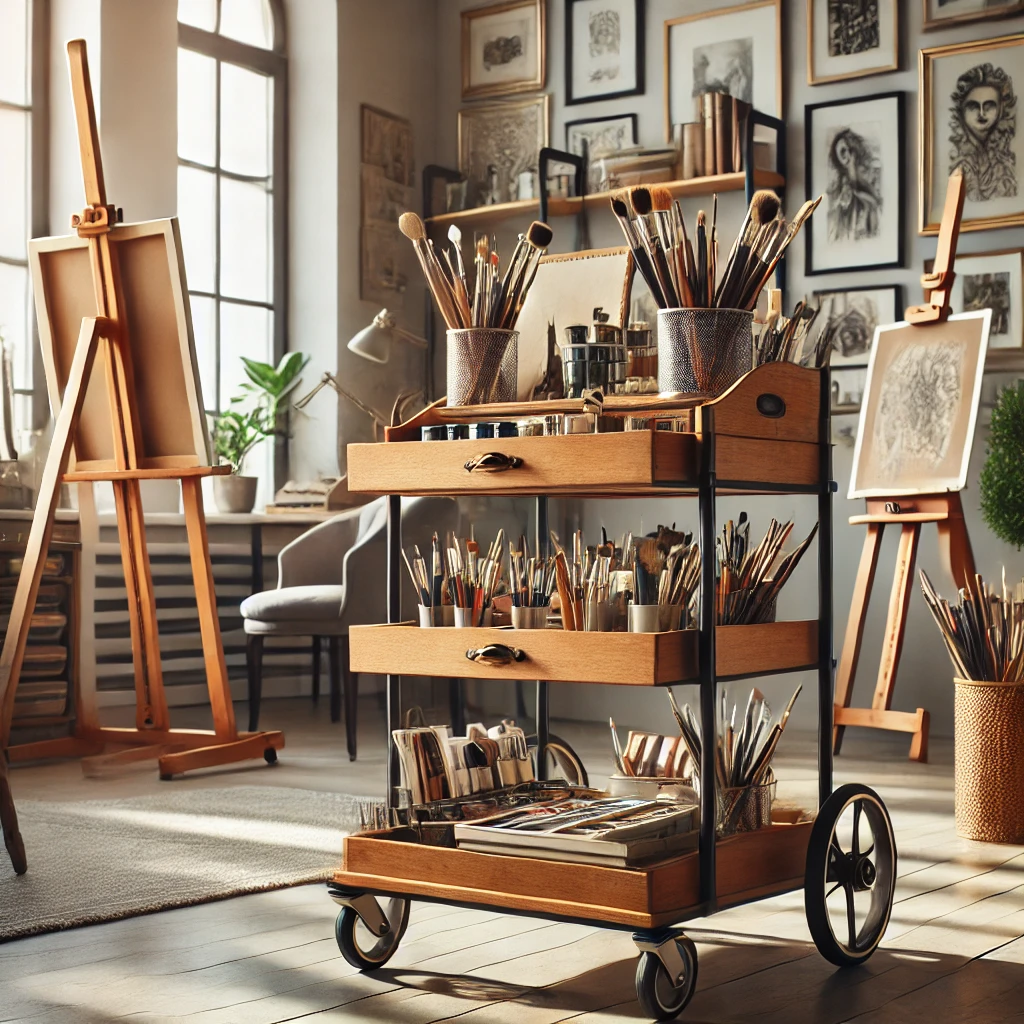
Here’s my take: the best art cart is the one sized to your desk, not your Pinterest board. A gorgeous cart that sits 4 inches too tall or rolls like a shopping cart with a bad wheel will end up parked in a corner holding mail. Get the height, width and casters right first, then pick the look you love. I’ll show you all three, plus the carts worth buying at every budget.
If you only do one thing: measure your desk height before you shop. The ideal cart top sits 1 to 3 inches below your desk surface, so you can slide things across without lifting and the cart tucks under the desk edge.
Quick Answer: The Best Rolling Art Carts at a Glance
- Best budget cart: YASONIC 3 Tier Rolling Cart, around $35
- Best with a work surface: DTK 3 Tier Metal Utility Rolling Cart with a table top and side bags, around $30
- Best slim cart for tight spaces: Aquiver Acrylic Slim Storage Cart, around $70
- Best for drawer lovers: Rebrilliant 20-drawer rolling cart (Wayfair)
- Best investment piece: MEEDEN solid beech 3-tier taboret cart, around $158
Why Artists Love Rolling Carts
A desk holds your work. A cart holds everything you need while you work, and it moves with you. Roll it to the easel for an oil session, to the kitchen table for a watercolor afternoon, then back into a closet when the room needs to be a room again.
Carts also solve the “everything on the desk” problem. When your palette, water and daily brushes live on a cart beside you, your desk stays clear for the paper.
The 4 Specs That Make or Break a Cart
Skip these and you’ll be shopping again in six months.
1. Height
Aim for a cart top 1 to 3 inches below your desk. Most standard desks are 28 to 30 inches tall, so a cart around 26 to 29 inches tall is the sweet spot. Easel painters can go a little taller, since you’re standing.
2. Width
- About 11 inches wide: slim carts that slide between a desk and a wall. Great for small studios, but they hold less and tip more easily.
- About 16 inches wide: the classic 3-tier utility cart. Room for a palette, a water jar and a brush caddy on one tier.
- 18 inches and up: wide carts for mixed media, where you need a tray of paints and a stack of collage paper side by side.
3. Casters
Look for casters 2 inches in diameter or larger if you’ll roll across a rug. Tiny 1 inch wheels catch on every rug edge and floor transition. And get at least two locking casters, so the cart stays put while you’re mixing paint on top of it.
4. Weight Capacity
Paint is heavy. A full tier of acrylic jars, gesso and mediums can easily reach 15 to 20 pounds. Check the per-tier rating, and look for steel or solid wood when you plan to load the bottom tier.
Modern Favorites
The Classic 3-Tier Utility Cart
This is the cart you’ve seen in every studio tour, and for good reason. Three mesh or metal baskets, a handle, and enough room for a full day’s supplies. The YASONIC is my budget pick: simple, sturdy for the price, and it comes in colors that suit a playful studio.
Metal Utility Storage Carts with Wheels, Craft Carts Organizer with Hanging Cups, Hooks, Mesh Basket for Bedside Kitchen Office Art, White

For a darker, more modern look, a matte black mesh cart disappears beside a black desk lamp and wood floor.
The Cart With a Work Surface
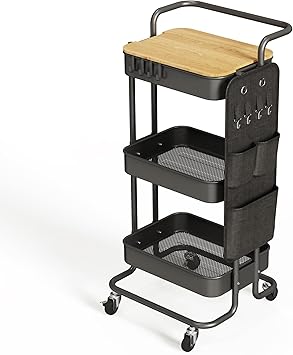
I love a cart with a flat top. It doubles as a side table for your palette or laptop, and the DTK adds side bags that are perfect for paper towels, a spray bottle and pencil cases.
Tray Storage Organizer Wheels, Art Craft 4 Hooks for Kitchen Bathroom Office Living Room (Black)
The Slim Cart
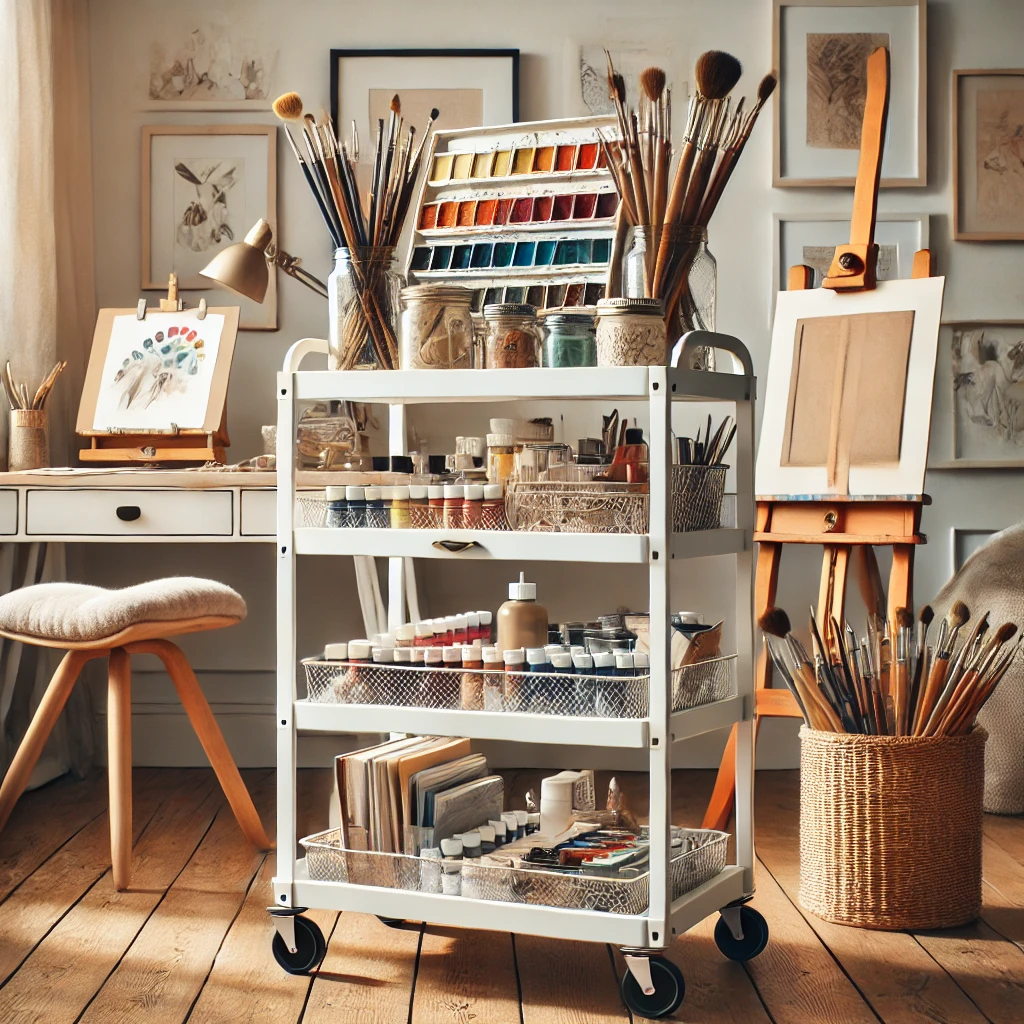
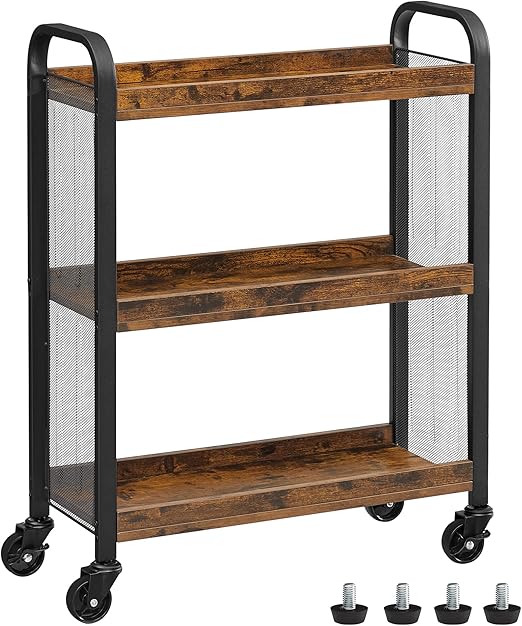
For a bedroom corner or the gap beside a desk, slim is everything. The Aquiver acrylic cart is clear, so it almost disappears visually, and you can see every supply at a glance. The VASAGLE is a sturdier narrow option with a wood-look finish.
3 Tier Utility Rolling Cart - for Kitchen, Bathroom, Living Room, Laundry, Narrow Places - 15.6'' L x 8.7'' W x 23.6'' H

Rolling Cart with Wheels, Steel Frame, Slim Storage Cart, Adjustable Feet Included, Industrial Style, Rustic Brown and Black
The Wide Cart for Mixed Media
Collage, paint and ephemera all at once need elbow room. Simple Trending makes a roomy cart that fits jars, trays and paper stacks without everything sliding into a heap.
3 Tier Bar Cart with Wheels, Heavy Duty Metal Storage Dining Cart for Kitchen, Black

Clear Acrylic and Chrome
If your studio leans glam or minimalist, an acrylic and chrome cart looks like furniture and keeps your prettiest supplies on display. Save it for pencils, brushes and pens, and let a sturdier cart haul the gesso.
Wood and Metal Hybrids
A Scandinavian-style wooden cart brings warmth to a white room and plays nicely with light oak desks. If floor space is tight, a compact 3-tier cart gives you the same idea in a smaller footprint.
Rolling Drawer Carts
If open baskets make you feel visually cluttered, drawers are your answer. Shallow drawers keep pencils, markers and tubes in single layers, sorted by category.
The Kingrack 12-drawer rolling cart with a wooden top gives you a work surface plus 12 drawers, and the Rebrilliant 20-drawer rolling cart is a dream for anyone with a big marker or pencil collection. One category per drawer, labeled on the front, and you’ll never dig again.
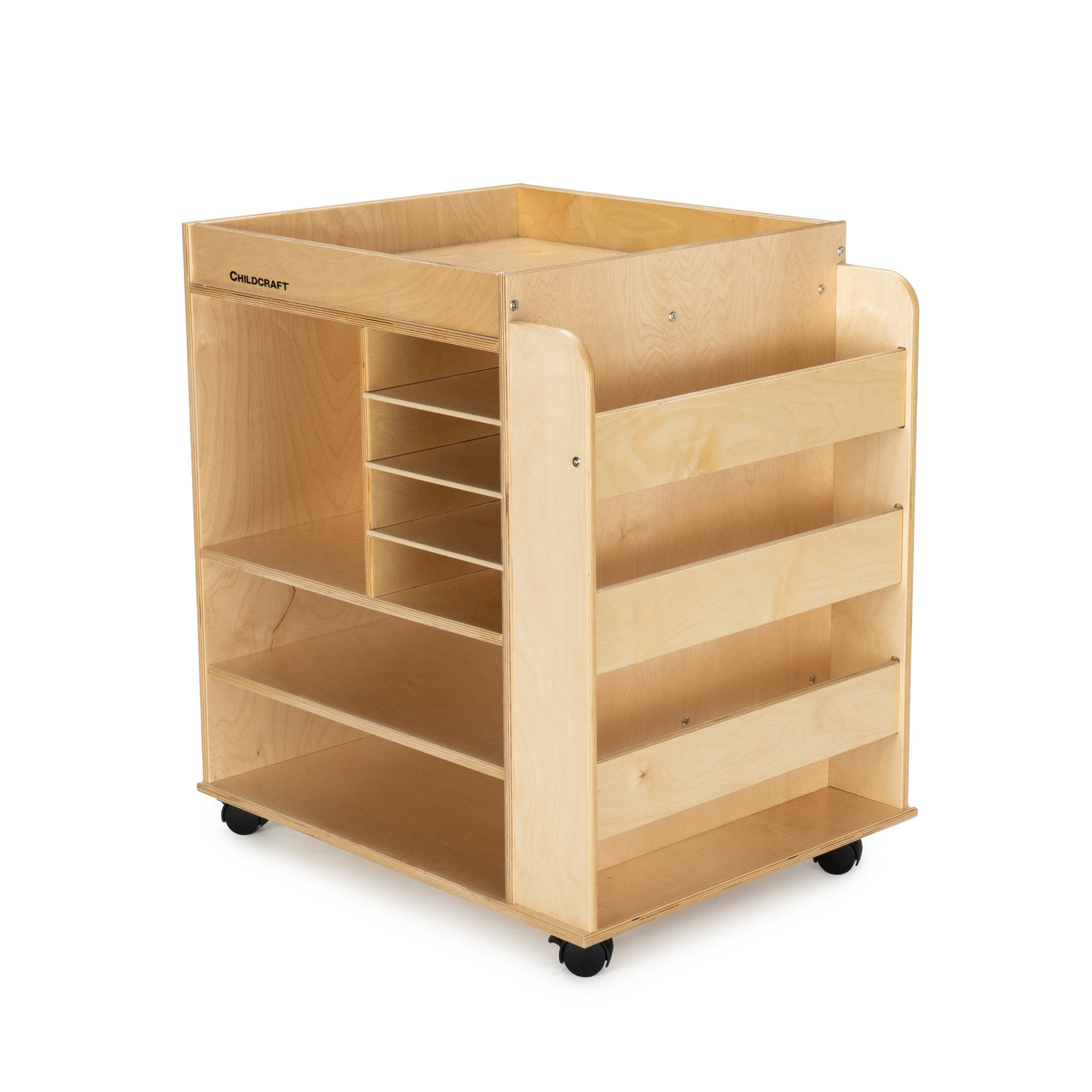
For a classroom-tough option with bins you can pull out and carry to the table, the Childcraft teaching cart is a workhorse.
Want more drawer ideas sized to your supplies? See my guide to the best drawer units for artists.
Vintage-Inspired Carts
Some carts are pure joy to look at, and that counts for something in a room where you make things.
- Antique gold and glass: an antique gold and glass bar-style cart turns a jar of brushes and a stack of sketchbooks into a vignette. Glass shelves are best for light, pretty supplies.
- Rustic wood and metal: a rustic wood and metal cart has an industrial farmhouse feel and handles heavier jars well.
- Victorian white metal: a Victorian-style white metal cart is sweet in a cottage or botanical studio, especially holding watercolor supplies and a little potted plant.
Building a whole look around vintage pieces? You’ll love these vintage art studio ideas.
Investment Pieces Worth It
Once you know a cart is a permanent part of how you work, it may be time to buy one built to last.
MEEDEN Rolling Art Supply Cart, solid beech, 3 tiers (around $158). This is a taboret, the classic painter’s side cart, made from solid beech with three wide tiers. It holds heavy paint and mediums without flexing, and it looks lovely beside a wooden easel. Worth it for: painters who work at an easel several times a week and want one cart for years. At $158 over 3 years of weekly sessions, that’s about $1 a session. Skip it if: you mostly draw at a desk with pencils and pens. A $35 utility cart does that job just fine. See the MEEDEN beech cart on Amazon.
7 Elements 6-Drawer Beechwood Art Supply Storage Box. Set this on the top of a sturdy cart and you’ve built a rolling pencil chest. Six shallow drawers keep colored pencils, pastels or tubes in one visible layer. Worth it for: colored pencil and pastel artists with a growing collection. Skip it if: you work mostly in big bottles and jars, which won’t fit shallow drawers. Read my full review of the 7 Elements beechwood box.
Ways to Use a Rolling Art Cart
- Marker station: markers stored flat or cap-down in shallow bins on the top tier, blending cards and paper in the middle.
- Watercolor cart: palette and two water jars on top (one to rinse, one clean), brushes and tape in the middle, paper pad on the bottom.
- Mixed media cart: glue, scissors and gel medium on top, collage papers and ephemera in the middle, heavy paint below.
- Filming cart: if you record your process, keep a phone mount, a small light and a lens cloth on one tier so setup takes 2 minutes.
- Daily tools cart: the 10 to 15 things you touch every session, and nothing else.
What to Store on Each Tier
A cart works best when every tier has one job.
- Top tier: daily essentials. Brushes in use, pencils, erasers, your palette. Anything you reach for more than once a session.
- Middle tier: paints and mediums. Sorted by color family or medium so you can grab without looking.
- Bottom tier: heavy and bulky. Gesso, water jugs, extra paper, refills. Heavy on the bottom keeps the center of gravity low, so the cart won’t tip when you roll it over a rug edge.
Do a 2 minute reset at the end of every session: anything you didn’t use goes back to its permanent home off the cart. A cart only stays useful while it holds today’s tools.
Styling Your Cart So It Looks Good in Photos
- Match the cart finish to one other thing in the room, like a black cart with a black lamp or a wood cart with a wood easel.
- Use matching containers on each tier. Three identical jars look intentional; three random mugs look like clutter.
- Add one living thing: a small plant or a jar of dried flowers on the top tier.
- Keep the top tier at about 60 percent full. Empty space reads as calm.
More ideas for making supplies look as good as they work: aesthetic art supply storage ideas.
How to Choose Your Cart in 60 Seconds
- Measure your desk height and subtract 1 to 3 inches. That’s your cart height.
- Measure the gap where it will live. Under 12 inches means slim cart.
- Rugs or floor transitions? Get 2 inch casters or larger, with locks.
- Heavy paints? Steel or solid wood, and check the per-tier weight rating.
- Then, and only then, pick the color and style that makes you happy.
The Takeaway
The right rolling art cart sits just below your desk, rolls smoothly on 2 inch locking casters, and carries only what you use every session. Start with a $30 to $35 utility cart to learn how you work, then upgrade to a solid wood taboret once your cart has earned a permanent spot.
Where would your cart live: beside the desk, next to the easel, or rolling between rooms? Tell me in the comments.
Save this to your art studio board so you have the height and caster rules handy when you shop.
[…] Best Rolling Art Carts […]